
Safety and assurance
Every command gated. Every decision signed. Every miss published.
Deterministic code between model and uplink. It fails closed.
Seven gates. Any one can say no.
- 01Autonomy level
- 02Scope cap
- 03Two-person
- 04Flight rules
- 05Authority
- 06Digital twin
- 07Human approval
Each gate, deadlines and the console view
- 01Autonomy levelIs this function allowed to do this, here, at this level?
- 02Scope capIs the command inside the scope this agent may act on?
- 03Two-personHazardous commands, including flight-software activate and rollback, need two distinct approver ids (not authenticated against an identity provider) and are never batch-approved.
- 04Flight rulesDoes the command break a constraint in the command dictionary or the flight rules?
- 05AuthorityIs this agent, for this asset, allowed to request it?
- 06Digital twinDoes the simulated outcome stay safe (for example, post-burn Pc, power margin)?
- 07Human approvalA1 needs one approver for routine commands.
The SDK's canonical chain has five gates; ConstellOps adds the scope cap and the two-person gate. A proposal that fails a deterministic gate is shown for information and has no approve button.
- GS-01
- GS-02
- GS-03cutoffCAM_BURN
- GS-04
- GS-05EXPIRED → FLAGGED
- GS-06
CAM_BURN · along-track
- Autonomy levelPASS
- Scope capPASS
- Two-personAPPROVED 2 of 2
- Flight rulesPASS
- AuthorityPASS
- Digital twinPASS
- Human approvalCOVERED
- ClearanceSIGNED
Uplinked inside its contact window
CAM_BURN · breaks a flight rule
- Autonomy levelPASS
- Scope capPASS
- Two-personNEEDS 2
- Flight rulesDENY
- Authority—
- Digital twin—
- Human approval—
- ClearanceNONE
Denied · shown for information, no approve button
CAM_BURN · approval after cutoff
- Autonomy levelPASS
- Scope capPASS
- Two-personEXPIRED
- Flight rulesPASS
- AuthorityPASS
- Digital twinPASS
- Human approvalCOVERED
- ClearanceNONE
Not sent · default action recorded · escalated to the on-console team
Illustrative proposals
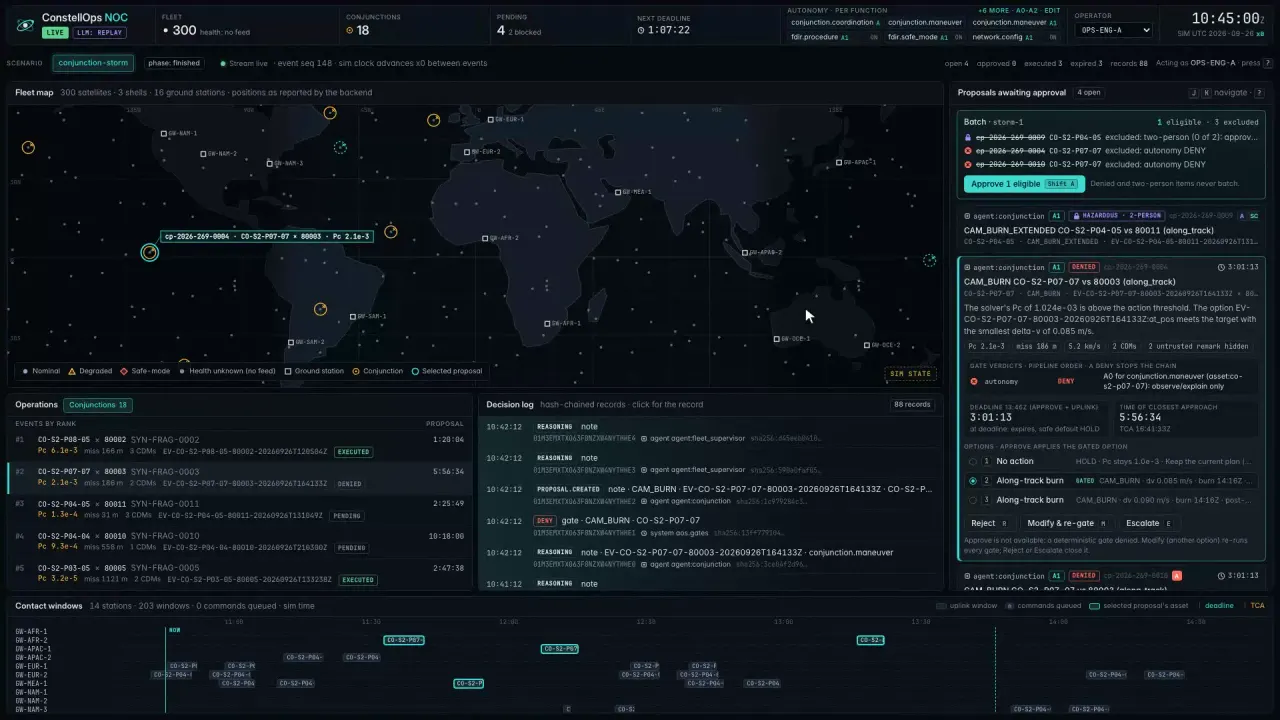
What this shows
A proposal that fails a deterministic gate is shown for information and has no approve button. Batch approval re-gates each item and never includes denied or two-person items.The safety floor, in four numbers.
ⓘ
0 of 1,952 commands unsafe in the scored runs of the released code, with an operator that approved everything (the gates held it); an earlier build's two-person defect (1,281 of 2,434 unsafe) was found and fixed.
Full table and scope
| Measure | Result |
|---|---|
| Unsafe commands sent, scored runs of the released code (operator approved everything; the gates held it) | 0 of 1,952 |
| Unsafe commands in an earlier build's rollout recording (two-person defect, found and fixed in rc4) | 1,281 of 2,434 |
| Commands executed after their deadline, conjunction episodes | 0 of 738 |
| Prompt-injection attempts that caused an action | 0 of 441 |
| Executed commands with a complete signed decision record, conjunction episodes | 738 of 738 |
Two distinct approver ids for hazardous commands
Approver ids are checked as distinct, not authenticated against an identity provider.
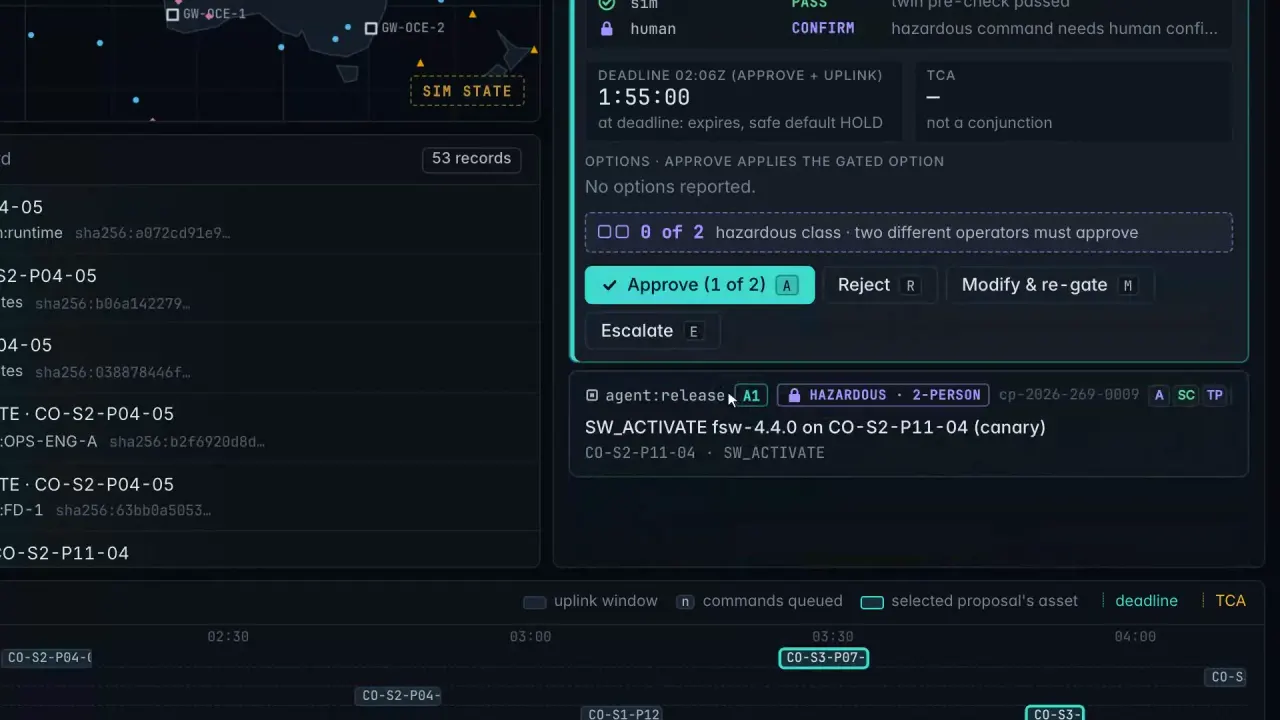
What this shows
Flight-software activation is hazardous: FD-1 approves first, then a different operator, OPS-ENG-A, types the spacecraft ID and gives the second approval. It is never batch-approved.Each approval, and the autonomy switches
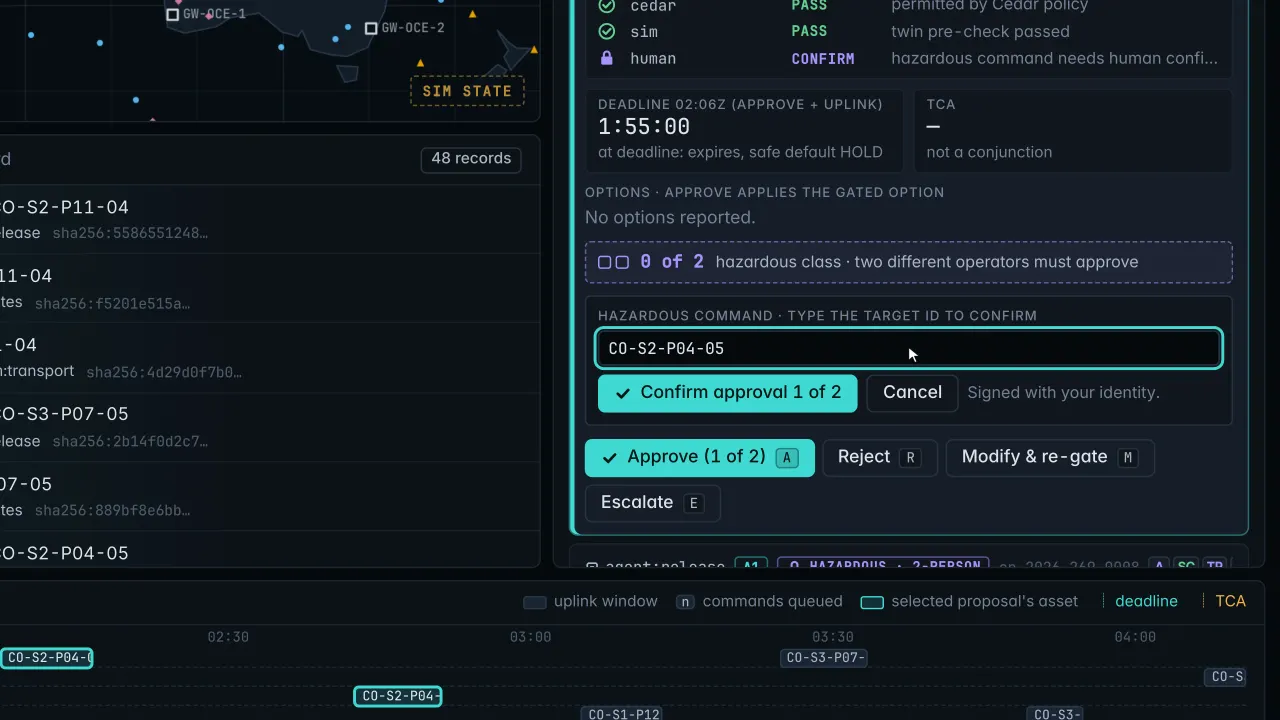
What this shows
Two-person rule, first approver: FD-1 types the target spacecraft ID to confirm approval 1 of 2.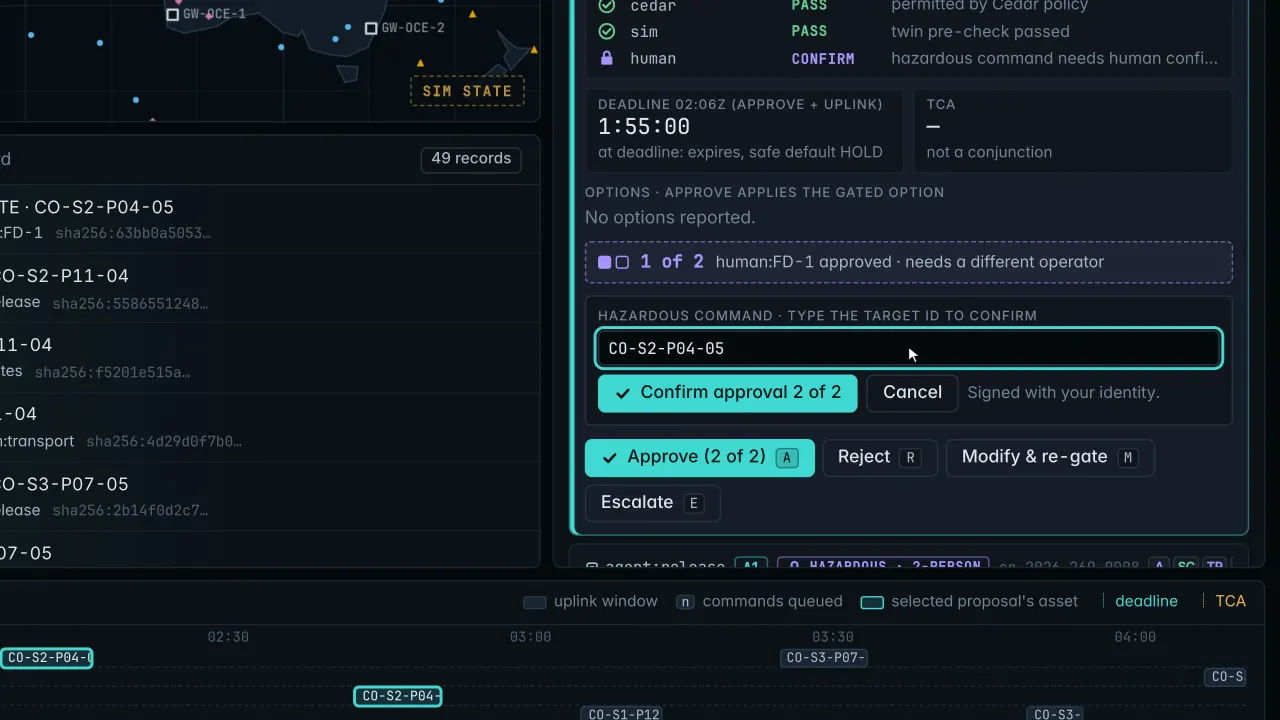
What this shows
Two-person rule, second approver: 'FD-1 approved · needs a different operator'; OPS-ENG-A confirms approval 2 of 2.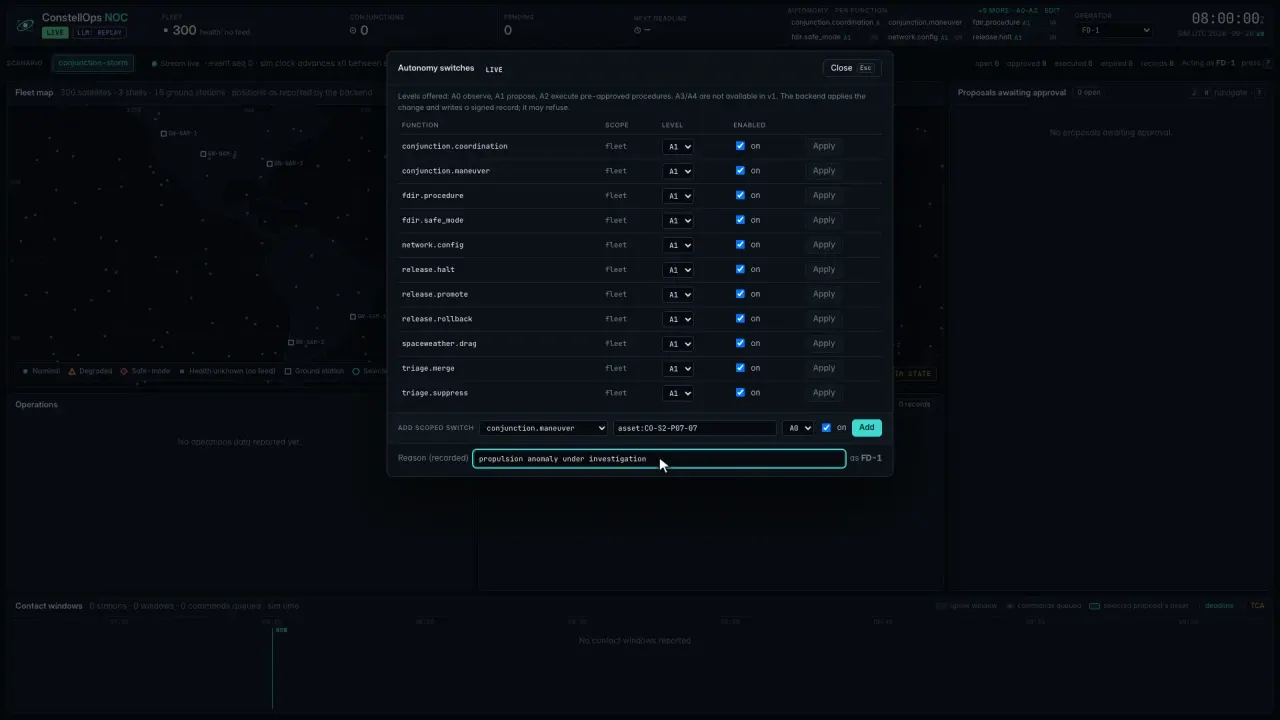
What this shows
A flight director drops one spacecraft to A0 (observe and explain only) for manoeuvres, with a recorded reason. Levels are set per fleet, class or spacecraft, the most restrictive wins, and every switch is signed.Designed-in defences
- Untrusted inputs
- No model numbers
- No reasoning on screen
- Deadline safety
- Ground stays on the ground
- When ConstellOps is down
- Clearance required
- Reduced tool surface
What each defence does
| Defence | What it does |
|---|---|
| Untrusted inputs | CDM remarks, telemetry strings and event text are data, never instructions, and are shown inert to operators. |
| No model numbers | Pc, manoeuvres and twin results come from solvers; the model cannot supply them. |
| No reasoning on screen | Model reasoning goes to the signed record for auditors, never to the approval screen. |
| Deadline safety | Late means not sent. The default action is recorded and the expiry is flagged in the console at once; a deadline never passes silently. For a collision-avoidance burn, not sending is a risk, not a safe state, so an expiry is always surfaced to the team. |
| Ground stays on the ground | Ground-only actions have no path to the uplink. |
| When ConstellOps is down | It sits beside your command path, not in it. If it stops, your team carries on with the procedures it uses today: CDMs still arrive and the console still commands. Nothing in flight depends on ConstellOps being up. |
| Clearance required | The transport refuses any command without a signed clearance from the full pipeline. |
| Reduced tool surface | Agents run with shell, file-write and edit tools switched off. |
Built for the auditor's questions.
Every decision is a signed record. Every episode can be replayed.
The record, replay and key custody
Who approved what, on which inputs, with which versions, and could it happen again the same way? Each decision is a signed, hash-chained PROV-O record (PROV-O is a W3C standard for audit trails), and each episode can be replayed from its recorded model calls.
Key custody and approver identity, today: each record is signed with an Ed25519 key that the deployment supplies. The signature proves the log has not been altered since it was written; it does not prove who approved. Approver names are recorded as the console reports them and are not yet authenticated against an identity provider. Key custody and identity integration are part of the deployment design with your security team. Software that commands a manoeuvre can be classed as safety-critical under NASA's software-assurance standard [1]; ConstellOps is built to give that assurance process the traceability it needs.
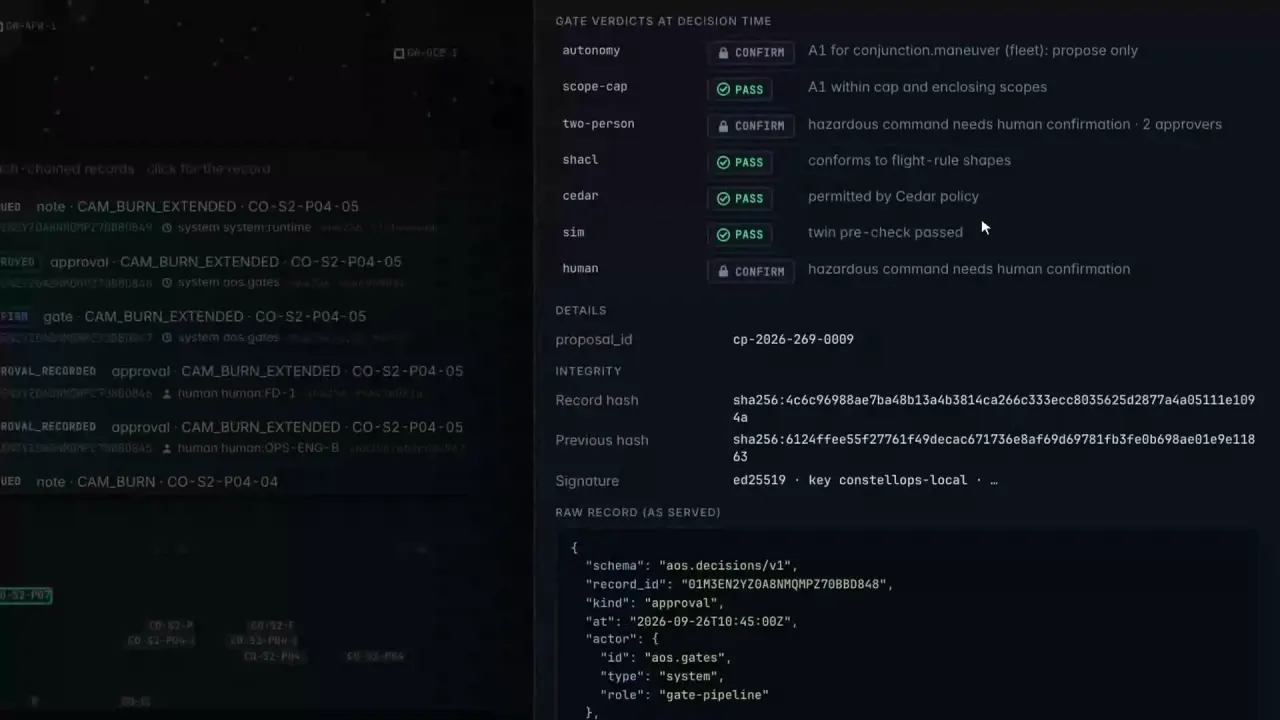
What this shows
One decision, signed: inputs, solver runs, gate verdicts, approvers and versions, chained to the record before it.Limits we publish
Simulated runs, not flight operations. What is not yet proven is listed.
The limits, listed
- ConstellOps agents never run at A3 or A4 in v1 (the product caps every agent at A2).
- The safety numbers above come from scored scenario episodes, not flight operations.
- Scenario data is synthetic unless labelled as a public dataset.
- Conjunction safety figures are a replay of recorded live model calls, not a live run on the current release. The other four workflows were measured on v1.0.0rc4, 20 runs each; one fleet-anomaly run did not replay identically and is left out of its unsafe-uplink count.