← All use cases

Use case · Space-weather surge

After the storm, re-baseline the fleet without dropping a deadline.

Stale assessments retired, the fleet re-baselined, approvals batched by deadline.
Storm surgedrag rises · assessments retired · re-baselined
GEOMAGNETIC ACTIVITYALTITUDE (DRAG)ASSESSMENTS
Illustrative · synthetic fleet · no figures
Simulation · Space-weather surgeSimulation
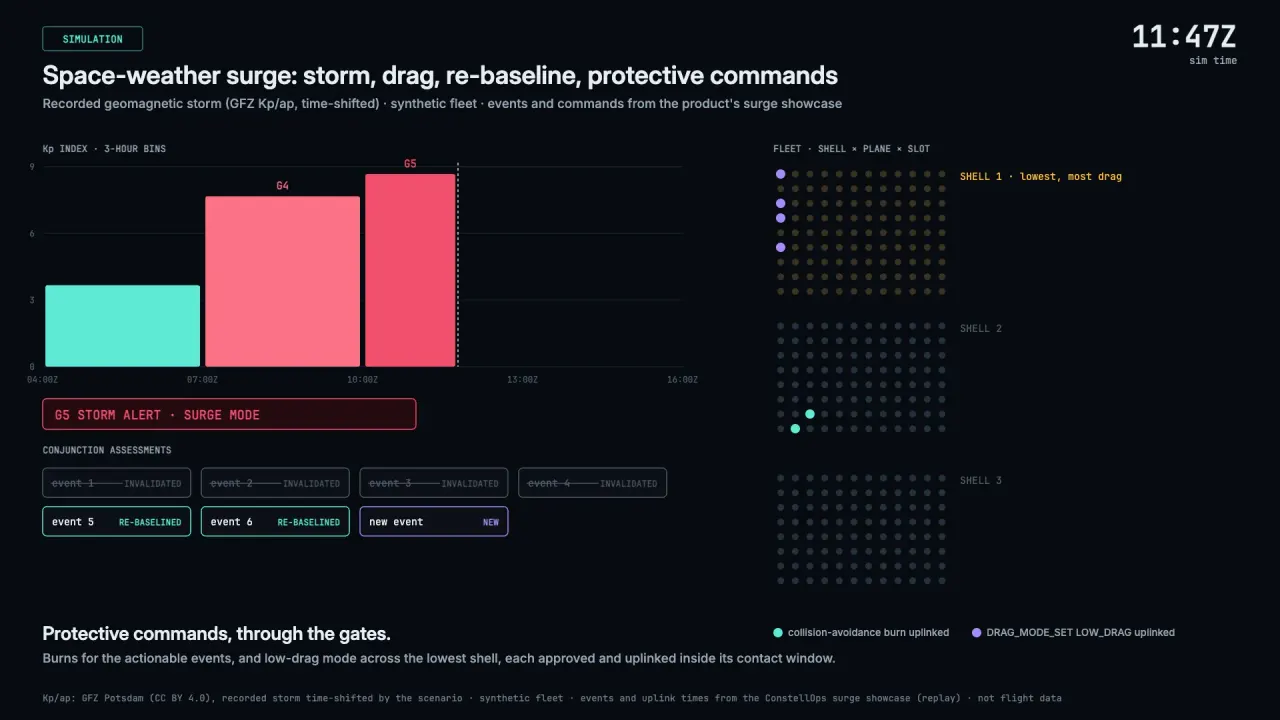
What this showsSimulation. A recorded severe storm builds. Surge mode marks pre-storm conjunction assessments stale, re-screening from post-storm states retires the invalidated ones and adds new events, and burns plus low-drag mode are uplinked inside their windows.
Simulation render · synthetic constellation [clip 1]

A surge puts every decision on deadline.

Storm-enhanced drag moves every trajectory.

The full picture

In the May 2024 storm, thousands of satellites manoeuvred at once, and researchers questioned whether existing conjunction-assessment procedures cope in storm conditions [1]. Every assessment made before the storm is suspect, the backlog arrives all at once, and the deadlines do not move.

How ConstellOps handles it

Procedure
  1. 01
    Surge mode
  2. 02
    Retire stale data
  3. 03
    Re-baseline
  4. 04
    Batch without blurring
  5. 05
    Keep service up
Each step in full
Procedure, in full
  1. 01
    Surge modeA storm alert puts the fleet supervisor into surge mode. It dispatches work; it never commands directly.
  2. 02
    Retire stale dataPre-storm CDMs and ephemerides are marked invalid and are not used for new decisions.
  3. 03
    Re-baselineOrbits are re-propagated from post-storm states by solvers, and conjunction assessment runs again.
  4. 04
    Batch without blurringProposals are batched for approval. Each keeps its own gate verdicts, deadline and default action, and anything that misses its cutoff is flagged to the on-console team at once.
  5. 05
    Keep service upThe network-incident agent tracks the capacity impact of manoeuvres and gateway effects.

One queue, same rules.

Autonomy level and approvals

Every agent in the surge runs at A1: a person approves every command. Batching groups items for review; it never changes what the gates allow.

Every deadline held through the surge.

0 of 11

high-risk missed
ⓘ

How it was measured

0 of 131

commands executed late
ⓘ

How it was measured

Full results table and notes

20 runs of a recorded geomagnetic storm replayed over a synthetic fleet, on ConstellOps v1.0.0rc4. No matched classical comparison exists for this workflow.

Space-weather surge results
MetricConstellOps
High-risk events missed during the surge0 of 11
Unneeded manoeuvres0 of 103
Commands executed after their deadline0 of 131
Commands that missed their cutoff0
Unsafe uplinks0 of 131
Runs that replay identically20 of 20

See it in the operations console

Operations console · Space-weather surgeReplay
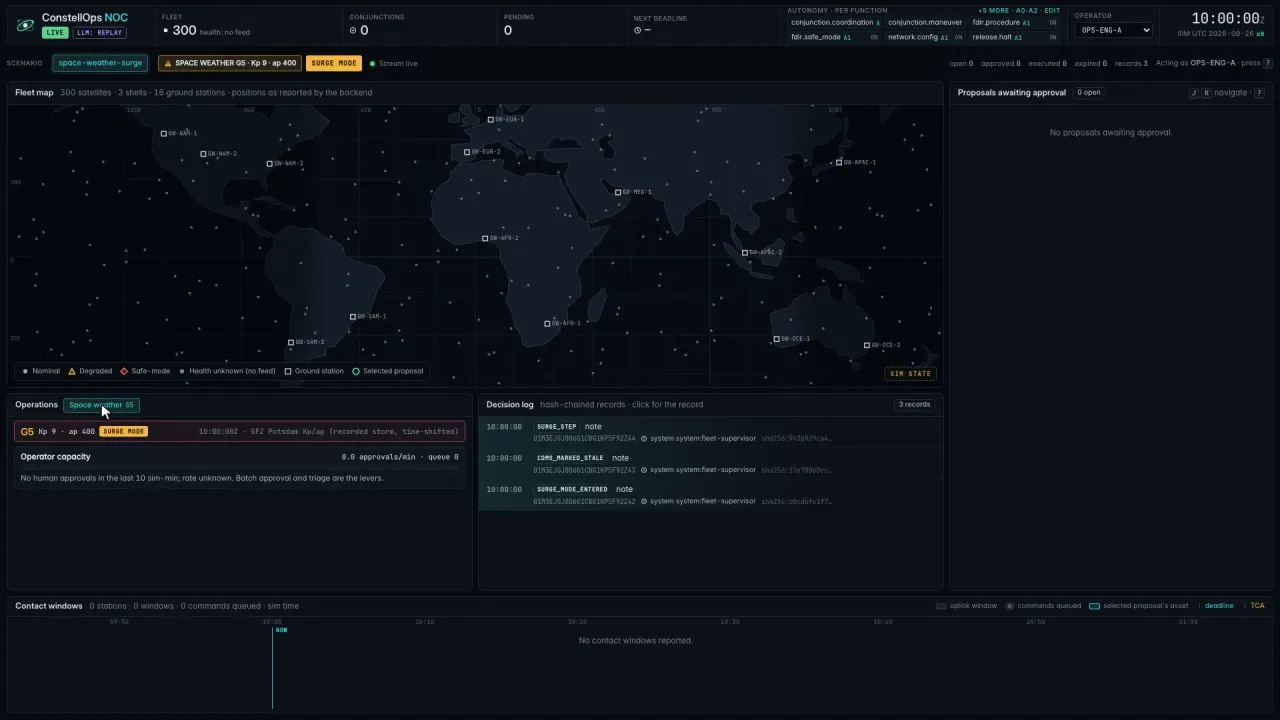
What this showsA recorded G5 storm. Pre-storm assessments are retired; the actionable events are re-proposed; burns and drag-mode commands are uplinked inside their windows.
Recorded replay · demonstration, not a benchmark [clip 2]Map positions illustrative [map 3]
More console captures
Operations console · Space-weather surgeReplay
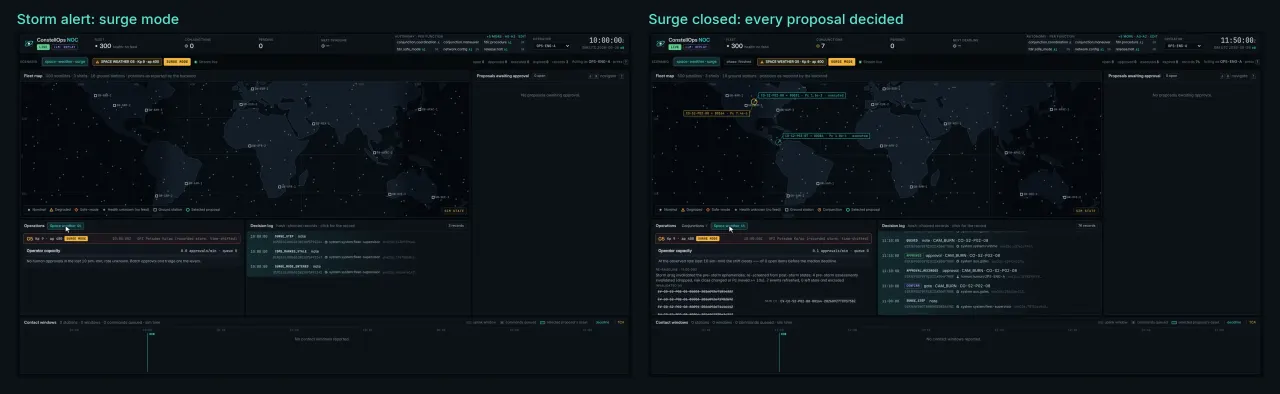
Storm onset and surge close in the operations console.
What this showsStorm onset and surge close in the operations console.
Recorded replay · demonstration, not a benchmark [clip 2]Map positions illustrative [map 3]
Operations console · Space-weather surgeReplay
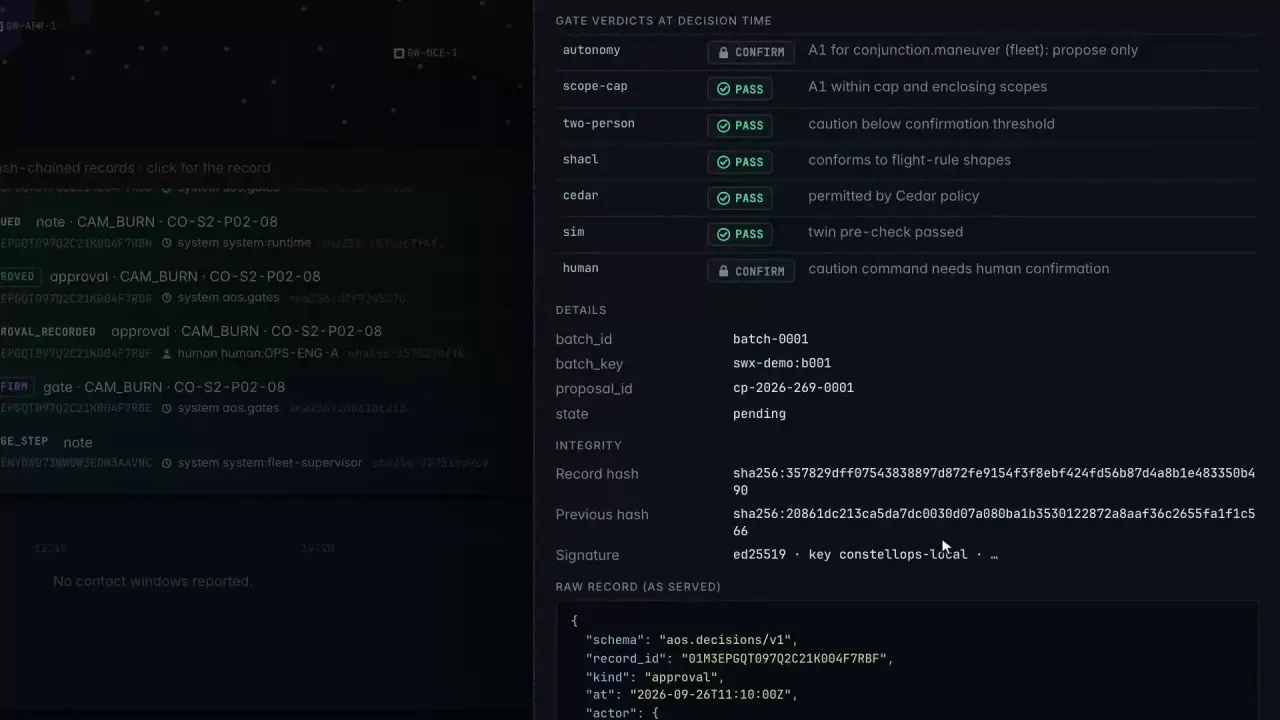
What this showsThe operator's signed approval of a collision-avoidance burn during the surge: provenance, gate verdicts and the integrity block.
Recorded replay · demonstration, not a benchmark [clip 2]Map positions illustrative [map 3]
Operations console · Space-weather surgeReplay
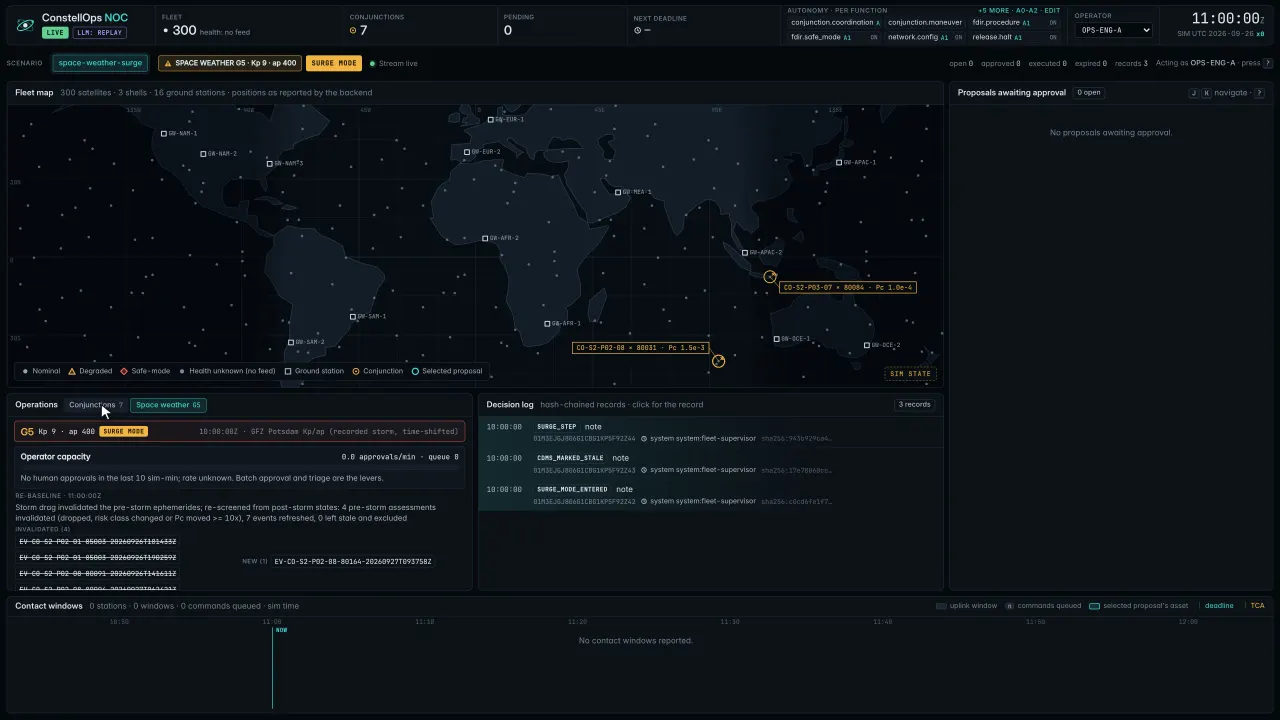
Re-baseline on post-storm states: invalidated assessments are retired and new events appear.
What this showsRe-baseline on post-storm states: invalidated assessments are retired and new events appear.
Recorded replay · demonstration, not a benchmark [clip 2]Map positions illustrative [map 3]
Operations console · Space-weather surgeReplay
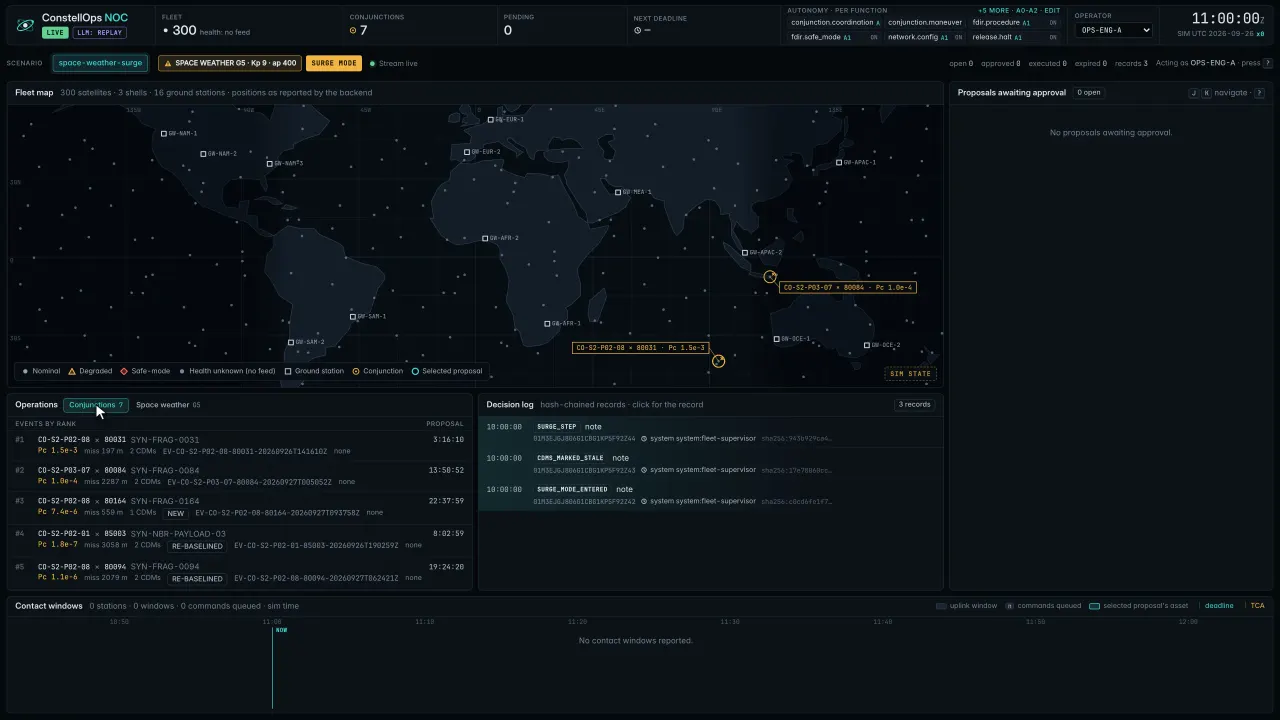
Conjunctions re-ranked on post-storm data, tagged RE-BASELINED or NEW.
What this showsConjunctions re-ranked on post-storm data, tagged RE-BASELINED or NEW.
Recorded replay · demonstration, not a benchmark [clip 2]Map positions illustrative [map 3]
Operations console · Space-weather surgeReplay
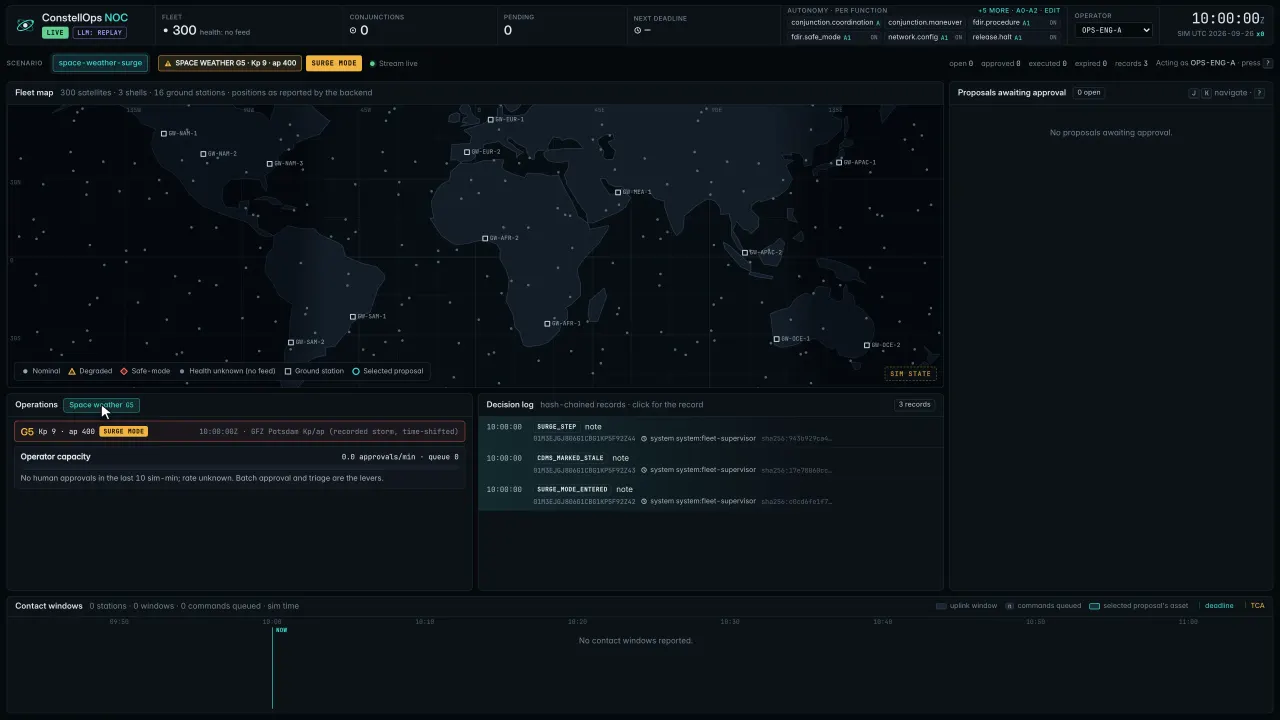
Storm alert: surge mode on, and pre-storm conjunction assessments marked stale.
What this showsStorm alert: surge mode on, and pre-storm conjunction assessments marked stale.
Recorded replay · demonstration, not a benchmark [clip 2]Map positions illustrative [map 3]
Operations console · Space-weather surgeReplay
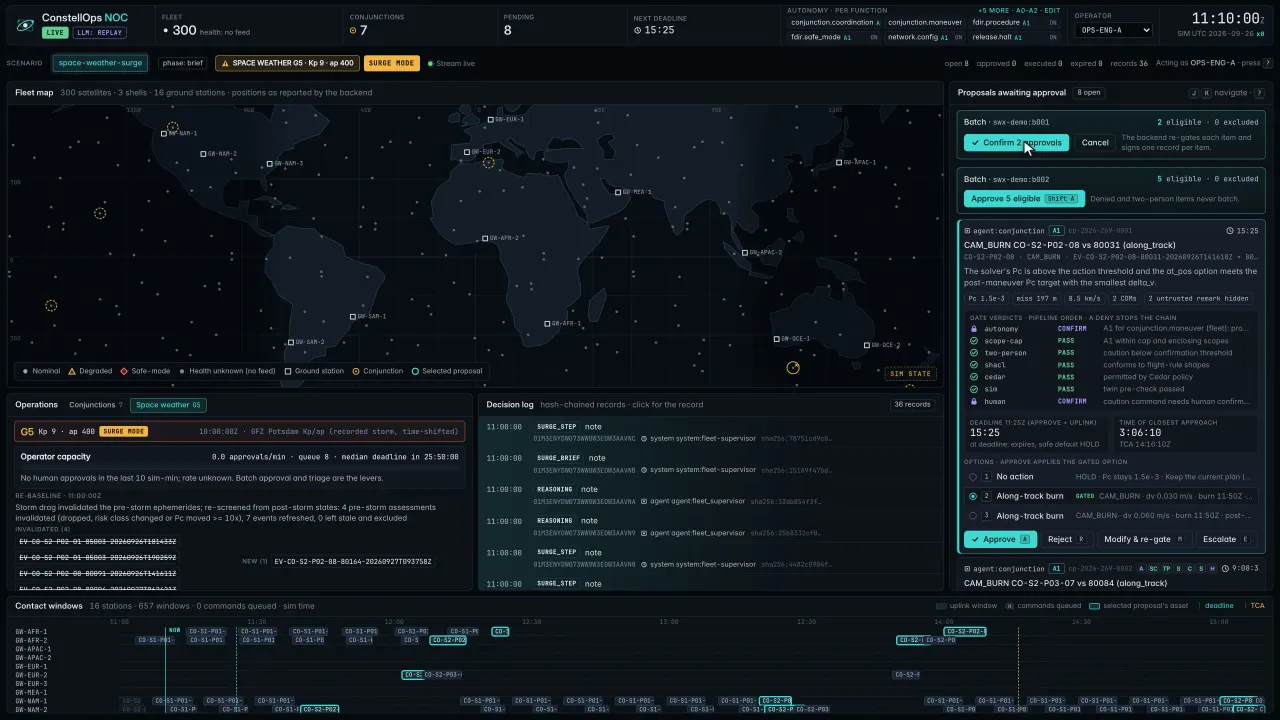
Surge batches keep the queue workable; each item is re-gated and signed.
What this showsSurge batches keep the queue workable; each item is re-gated and signed.
Recorded replay · demonstration, not a benchmark [clip 2]Map positions illustrative [map 3]

What it is not

Not a space-weather forecast. It consumes alerts.

The limits, listed
  • Not a space-weather forecast. It consumes alerts.
  • Not onboard drag response.

§ · NEXT PASS

Request a briefing.

A 45-minute session with the evidence behind any figure. Operators can send a week of their queue.

This address is used only to reply to you. The site sets no cookies and loads no trackers.

Briefing requests

About the clips and captures on this page

  1. Rendered offline (2D canvas) from the ConstellOps v1.0.0rc4 space-weather-surge showcase: the scenario's GFZ Kp 3-hour bins (a recorded severe storm, time-shifted), the storm alert, the re-baseline counts (invalidated, re-baselined, new), and the uplink times of the collision-avoidance burns and DRAG_MODE_SET commands. G-levels follow the NOAA scale.
  2. ConstellOps operations console v1.0.0rc4, space-weather-surge showcase (recorded G5 storm indices, synthetic fleet), replay of recorded Amazon Nova Pro calls, in-memory link, simulated clock. Single demo run, not a benchmark.
  3. Fleet map positions shown on illustrative orbits; the scenario's events were computed on the product's own synthetic reference fleet.

Sources and labels for every figure on this page (7)

  1. — In the May 2024 storm, thousands of satellites began to manoeuvre en masse; the authors question the capabilities of existing conjunction assessment procedures during geomagnetic storm conditions.

    Industry fact · Parker and Linares, arXiv:2406.08617 · source

  2. 0 of 11 High-risk events missed during the surge: 0 of 11

    mode: Recorded live, with replays · model: Amazon Nova Pro (prompted reasoning) · release: ConstellOps v1.0.0rc4 · runs: 19 runs recorded live, 1 replayed · n: 20 seeds (11 actionable events pooled) · scenario: space-weather surge (recorded geomagnetic storm replayed)

  3. 0 of 131 Commands executed after their deadline: 0 of 131

    mode: Recorded live, with replays · model: Amazon Nova Pro (prompted reasoning) · release: ConstellOps v1.0.0rc4 · runs: 19 runs recorded live, 1 replayed · n: 131 uplinked commands over 20 surge runs · 95% range: 0–0.028 · scenario: space-weather surge (recorded geomagnetic storm replayed)

  4. 0 of 103 Unneeded manoeuvres: 0 of 103 low-risk events

    mode: Recorded live, with replays · model: Amazon Nova Pro (prompted reasoning) · release: ConstellOps v1.0.0rc4 · runs: 19 runs recorded live, 1 replayed · n: 20 seeds (103 below-threshold events pooled) · scenario: space-weather surge (recorded geomagnetic storm replayed)

  5. 0 Commands that missed their cutoff: 0

    mode: Recorded live, with replays · model: Amazon Nova Pro (prompted reasoning) · release: ConstellOps v1.0.0rc4 · runs: 19 runs recorded live, 1 replayed · n: 20 seeds (20 runs, 19 recorded live and 1 replayed) · scenario: space-weather surge (recorded geomagnetic storm replayed)

  6. 20 of 20 Runs that replay identically: 20 of 20

    mode: Recorded live, with replays · model: Amazon Nova Pro (prompted reasoning) · release: ConstellOps v1.0.0rc4 · runs: 19 runs recorded live, 1 replayed · n: 20 seeds · scenario: space-weather surge (recorded geomagnetic storm replayed)