← All use cases

Use case · Conjunctions and collision risk

Triage every conjunction. Escalate the ones that matter, before the deadline.

Alerts grouped and ranked, with solver-computed options before the uplink cutoff.
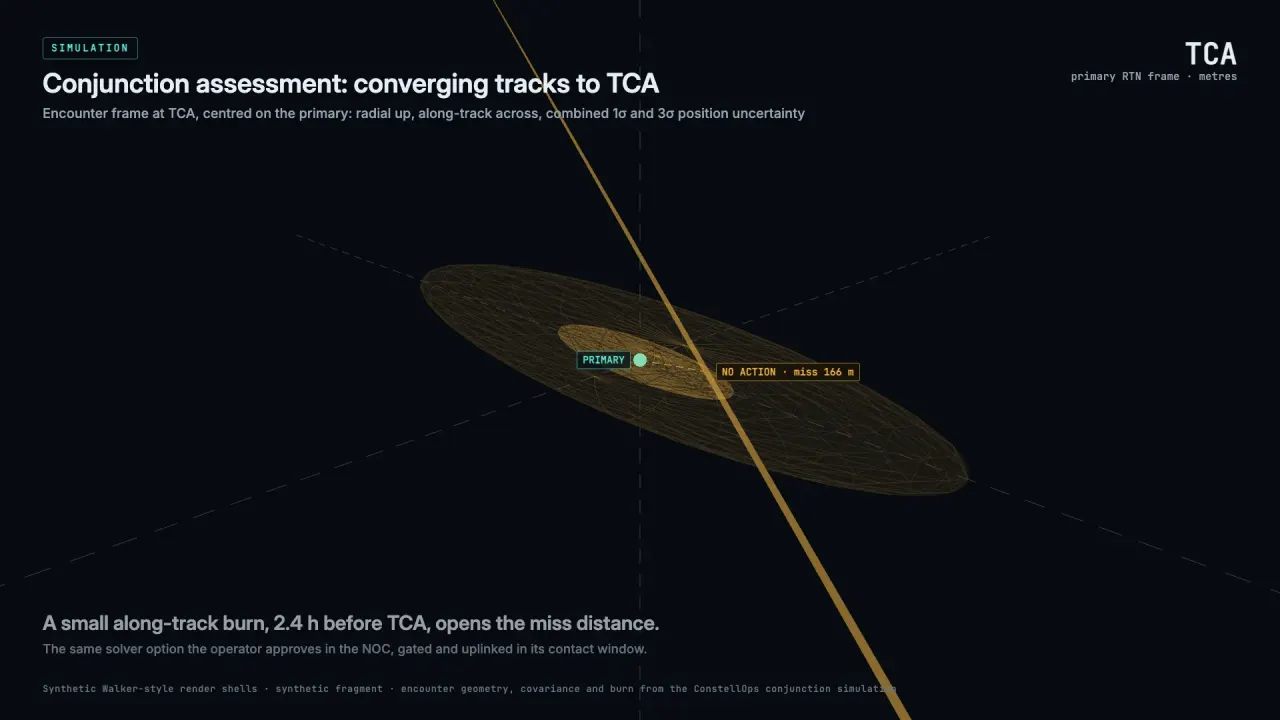
Encounter planecovariance ellipse · miss vector · hard-body radius
B-PLANE (ILLUSTRATIVE)misspost-burn
Illustrative · synthetic fleet · no figures
Simulation · ConjunctionsSimulation
What this showsSimulation. Screening flags a close approach between a spacecraft and a fragment. The tracks converge to the time of closest approach; in the encounter frame, the no-action pass falls inside the combined position uncertainty, and a small along-track burn made earlier in the orbit opens the miss distance.
Simulation render · synthetic constellation [clip 1]

Hundreds of alerts a week. Miss none.

A typical low-orbit satellite receives hundreds of collision alerts every week, and about 2 of them per satellite need hours of analysis each.

The full picture

Screening services flag close approaches; risk assessment is still the operator's job. A widely used mitigation threshold is Pc 1e-4, and many operators set a stricter one; each manoeuvre is expected to be screened and coordinated with the other operator. In ConstellOps the threshold is an operator setting. False alerts burn propellant and lifetime. A missed one can create debris.

How ConstellOps handles it

Procedure
  1. 01
    Ingest
  2. 02
    Rank
  3. 03
    Compute, don't guess
  4. 04
    Gate
  5. 05
    Screen the new orbit
  6. 06
    Uplink, or escalate
  7. 07
    Coordinate
Each step in full
Procedure, in full
  1. 01
    IngestCCSDS CDMs are ingested as untrusted data. Updates are grouped into one event per object pair and TCA; the latest message is authoritative, and every source message is kept.
  2. 02
    RankThe conjunction agent ranks events by risk and by time to the decision deadline (TCA minus lead time).
  3. 03
    Compute, don't guessPc and manoeuvre options come from solver tools. When a CDM lacks what is needed to recompute Pc (absolute states, hard-body radius), ConstellOps says so, uses the originator's reported value, and escalates the event to a human.
  4. 04
    GateA manoeuvre or no-manoeuvre proposal passes flight rules, authority policy, a twin check of post-burn Pc, and its autonomy level. Hazardous burns need two distinct approvers.
  5. 05
    Screen the new orbitConstellOps prepares the planned post-manoeuvre ephemeris as a CCSDS OCM for your screening provider, so the burn is screened against the catalogue before uplink. A person submits it.
  6. 06
    Uplink, or escalateThe approved burn is queued for uplink in a specific pass and time-tagged for onboard execution at the planned burn epoch. If approval or uplink misses the cutoff, the burn is not sent. The event's default action (for a collision-avoidance burn, no manoeuvre) is recorded, and the expiry is flagged in the console at once, so the on-console team can act on its existing manual path. A deadline never passes silently.
  7. 07
    CoordinateA coordination package (CCSDS CDM/OCM plus rationale) is prepared for the other operator. A human sends it.

Proposes. Never commands on its own.

Autonomy level and approvals

The conjunction agent runs at autonomy level A1: it proposes, and a human approves every manoeuvre and every no-manoeuvre decision. Levels are set per satellite, per class or fleet-wide, and every change is signed into the decision log.

A conservative operating point, published with its costs.

0 of 33

high-risk missed
ⓘ

How it was measured

0.326

unneeded-burn rate
ⓘ

How it was measured

Fresh runs: 0 of 40 high-risk missed, same as a tuned solver, at ~3× its unneeded manoeuvres.

Full results table and notes

A benchmark-generated conjunction storm of 10 events over 24 hours per seed, 60 seeds, the same seeds for every policy. ConstellOps figures replay a recorded live Amazon Nova Pro campaign. The classical solver and the scripted analyst runbook were each run across a range of escalation thresholds on the same runs. The classical solver column is the solver at the stricter threshold that matches the agent's miss count (Pc 2e-5, chosen on these runs, then checked on 60 held-out runs); the runbook column is the runbook at its best threshold (Pc 5e-5). The held-out rows (seeds 60–119) are ConstellOps v1.0.0, recorded live on Amazon Nova Pro and replayed, beside the tuned solver and the runbook at its default threshold (Pc 1e-4).

Conjunctions results
MetricConstellOpsClassical solver (tuned)Scripted analyst runbook (best)
High-risk events missed0 of 330 of 333 of 33
Low-risk events given an unneeded manoeuvre (false-manoeuvre rate)0.326 (higher than both baselines)0.1060.051
Fuel used per 1,000 events (Δv)4.05 m/s0.273 m/s—
Hours of warning before closest approach (median decision lead time, higher is better)3.10 h8.0 h—
Held-out runs (seeds 60–119): high-risk events missed (runbook at its default threshold)0 of 400 of 406 of 40
Held-out runs: false-manoeuvre rate0.295 (165/560)0.089—
Held-out runs: fuel used per 1,000 events (Δv)3.93 m/s0.30 m/s—
Held-out runs: hours of warning before closest approach (median, higher is better)2.726 h8.0 h—
Held-out runs: unsafe commands sent0 of 205——

See it in the operations console

Operations console · ConjunctionsReplay
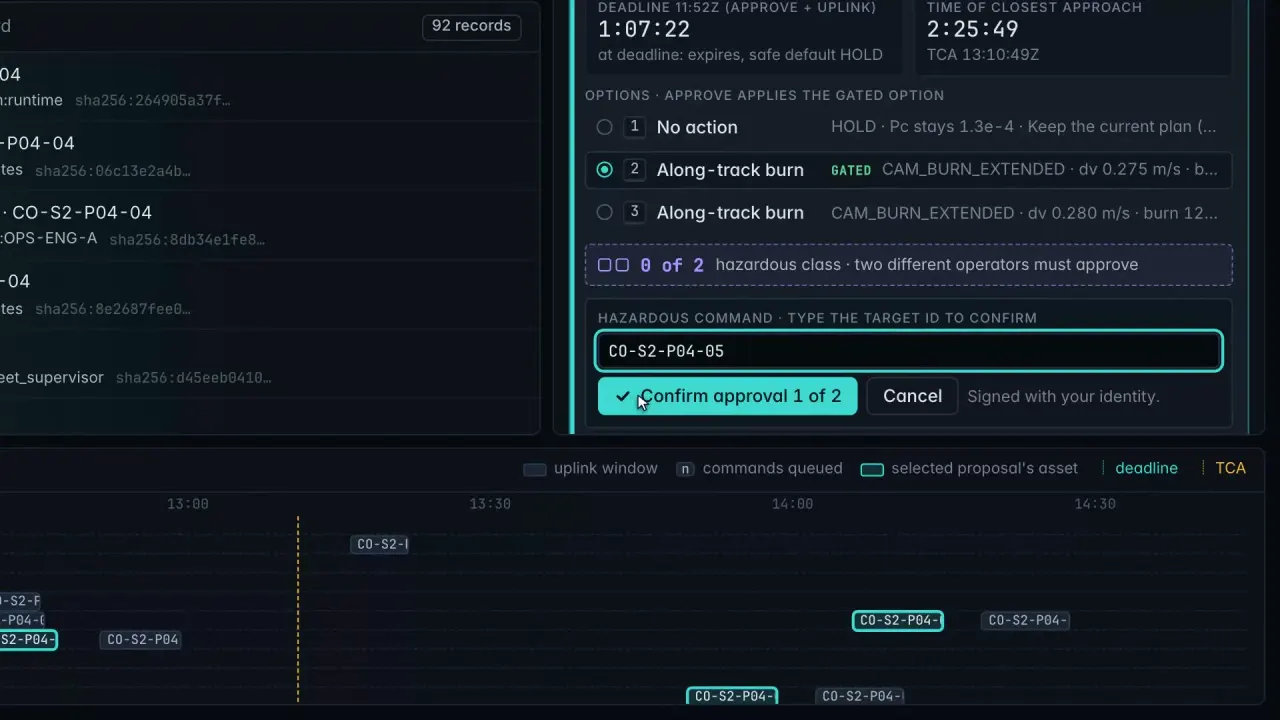
What this showsA storm of conjunction messages. The agent ranks events by deadline; proposals that break a rule are denied by the gates; a hazardous burn waits for a second approver; approved burns uplink inside their windows; items that missed their cutoff are not sent, and the expiry is flagged to the on-console team.
Recorded replay · demonstration, not a benchmark [clip 2]Map positions illustrative [map 3]
More console captures
Operations console · ConjunctionsReplay
Pc and the post-burn Pc come from solver runs, linked from the card.
What this showsPc and the post-burn Pc come from solver runs, linked from the card. "No action" is always an option, with its consequence.
Recorded replay · demonstration, not a benchmark [clip 2]Map positions illustrative [map 3]
Operations console · ConjunctionsReplay
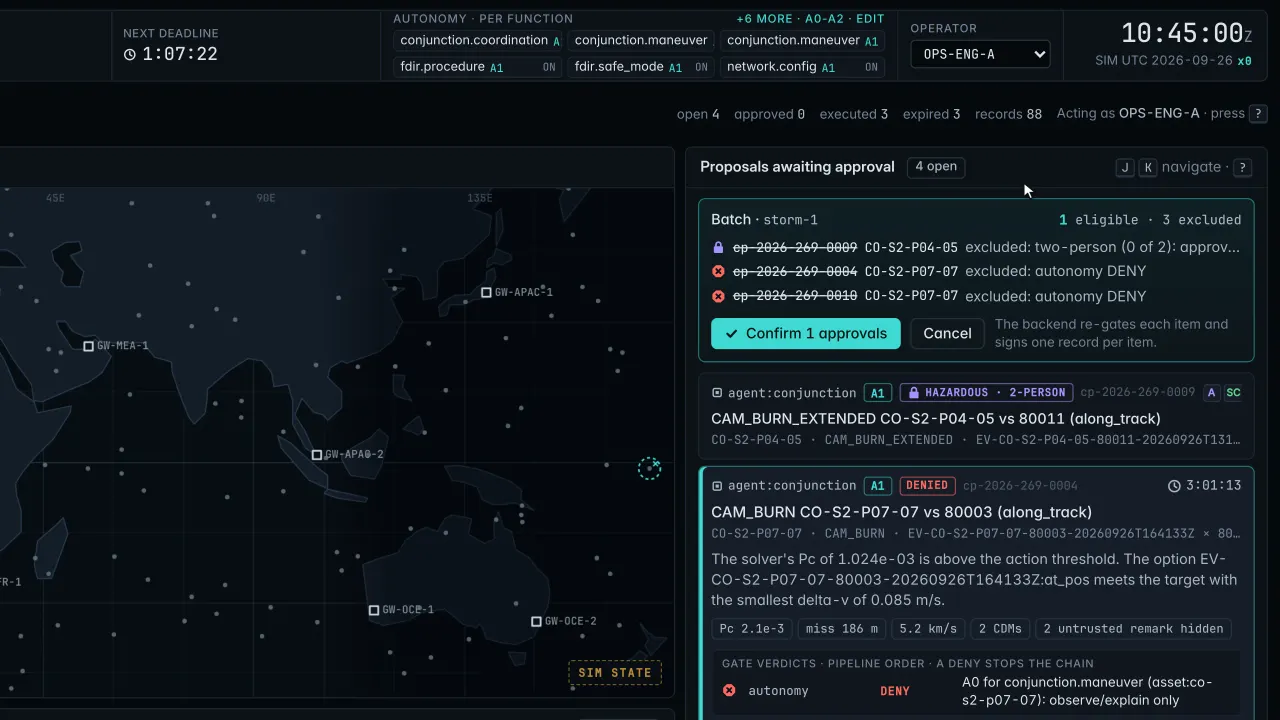
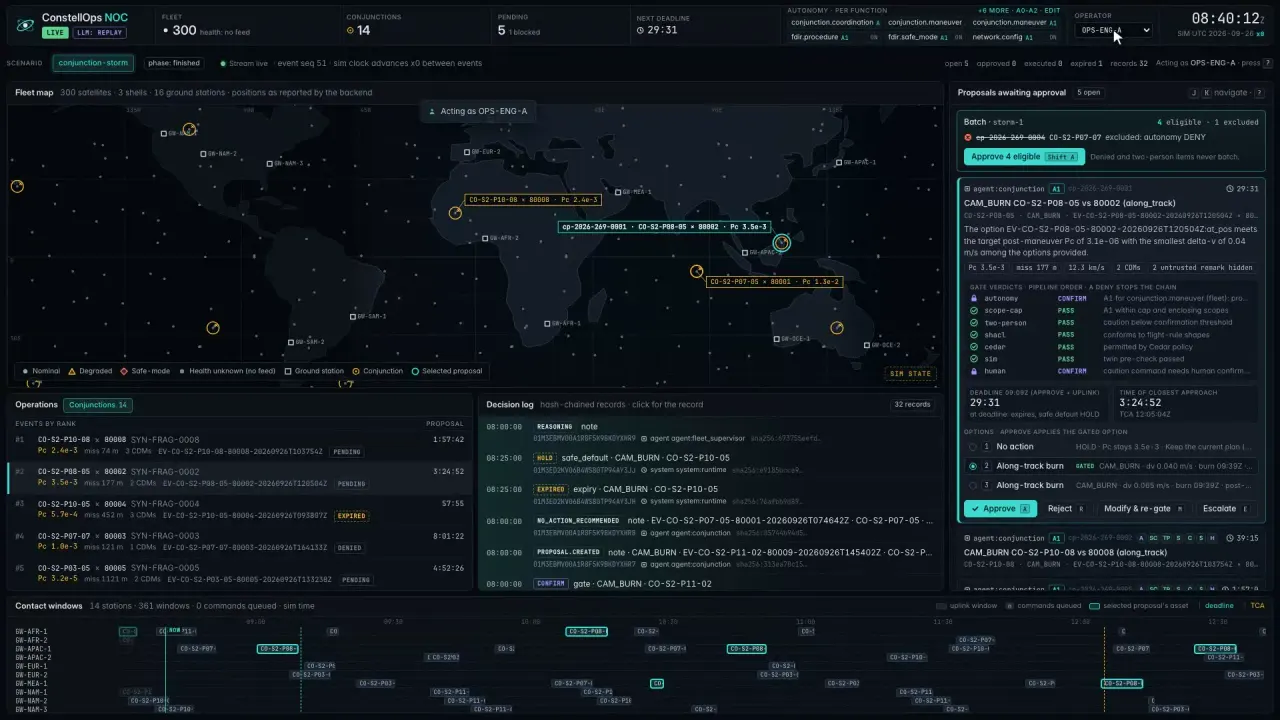
Batch approval lists what it will not approve: two-person and gate-denied items never batch.
What this showsBatch approval lists what it will not approve: two-person and gate-denied items never batch.
Recorded replay · demonstration, not a benchmark [clip 2]Map positions illustrative [map 3]
Operations console · ConjunctionsReplay
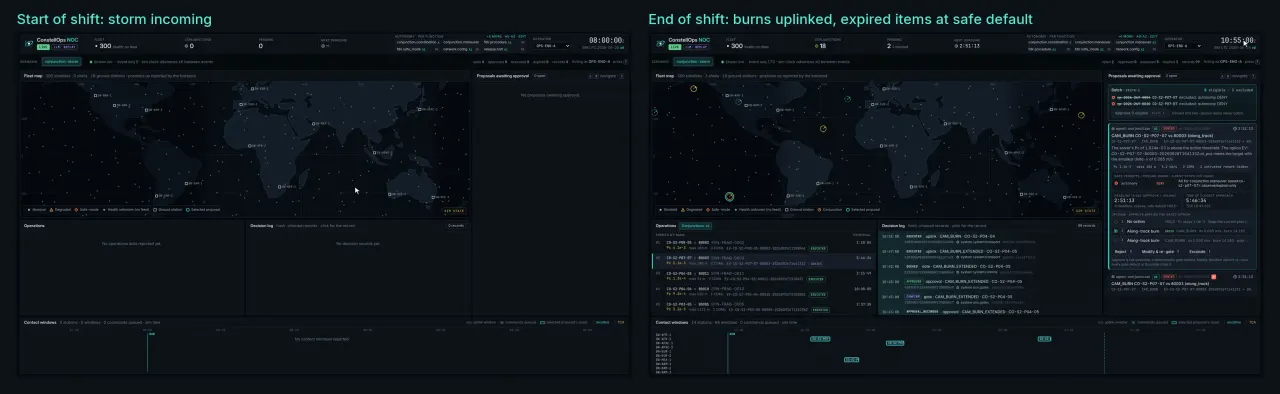
Start and end of the shift in the operations console.
What this showsStart and end of the shift in the operations console.
Recorded replay · demonstration, not a benchmark [clip 2]Map positions illustrative [map 3]
Operations console · ConjunctionsReplay
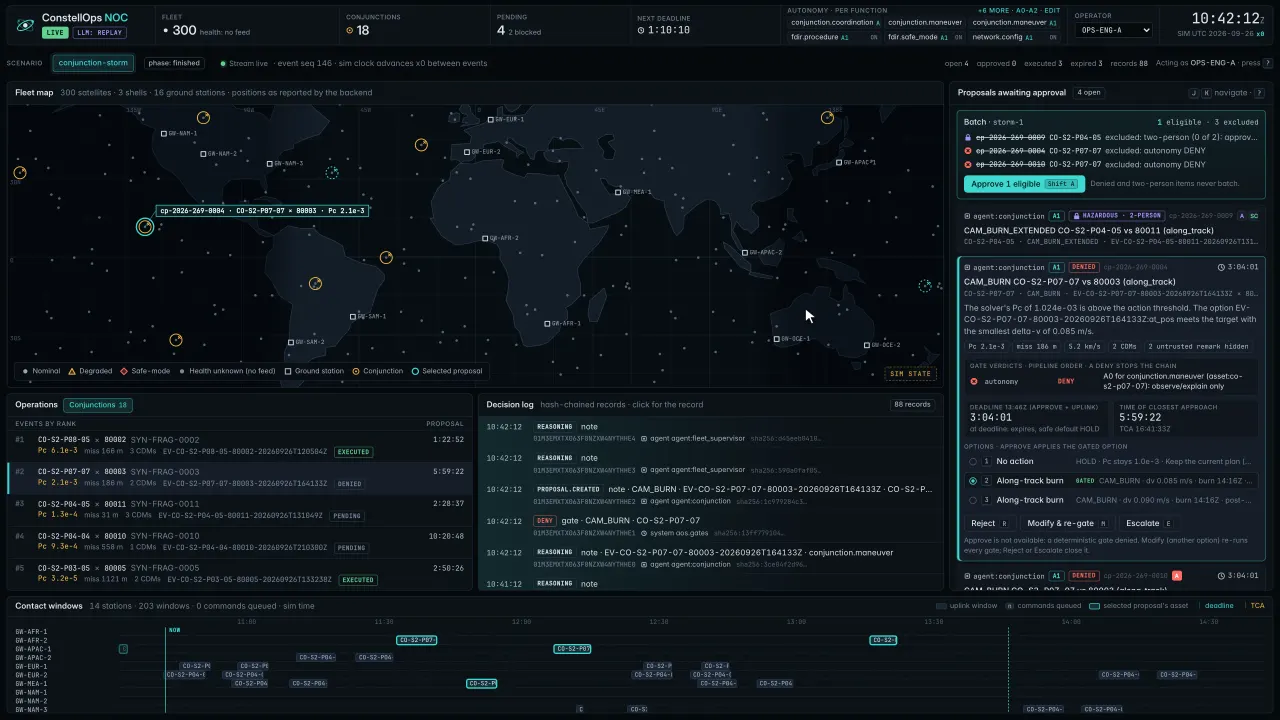
The operations console mid-storm: conjunctions on the fleet map, events ranked by deadline, the hash-chained decision log, proposals awaiting approval and contact windows.
What this showsThe operations console mid-storm: conjunctions on the fleet map, events ranked by deadline, the hash-chained decision log, proposals awaiting approval and contact windows.
Recorded replay · demonstration, not a benchmark [clip 2]Map positions illustrative [map 3]
Operations console · ConjunctionsReplay
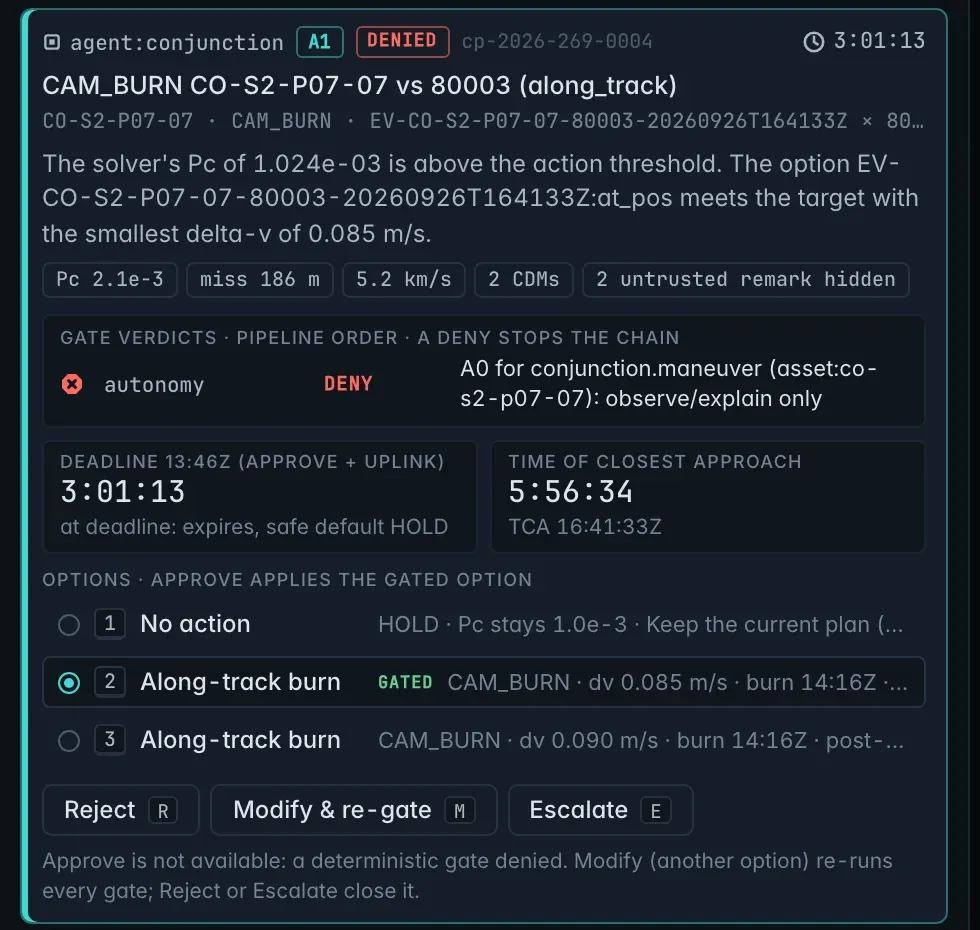
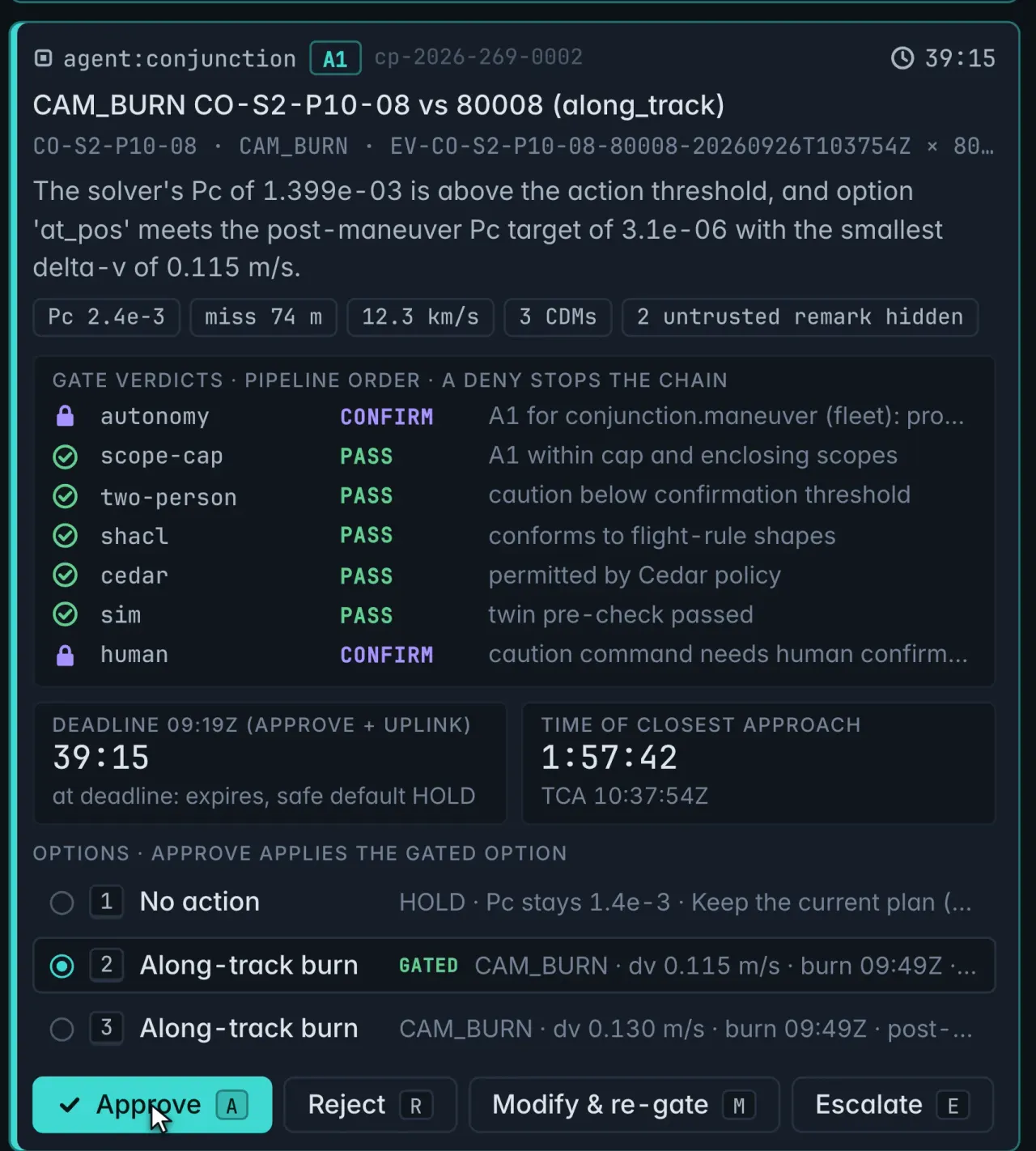
A manoeuvre proposal: action, targets, uplink cutoff and TCA countdown, gate verdicts, alternatives including no action, and the provenance of every number.
What this showsA manoeuvre proposal: action, targets, uplink cutoff and TCA countdown, gate verdicts, alternatives including no action, and the provenance of every number.
Recorded replay · demonstration, not a benchmark [clip 2]Map positions illustrative [map 3]
Operations console · ConjunctionsReplay
What this showsA conjunction storm in the operations console. Agents rank events and propose manoeuvres; the gates deny what breaks a rule; operators approve the rest, including a two-person approval; approved burns uplink in their contact windows; expired items are not sent; each records its default action (for a burn, no manoeuvre) and is flagged to the on-console team.
Recorded replay · demonstration, not a benchmark [clip 2]Map positions illustrative [map 3]

What it is not

Not onboard autonomous collision avoidance.

The limits, listed
  • Not onboard autonomous collision avoidance.
  • Not a screening service. It consumes CDMs.
  • Not automatic negotiation with other operators. It prepares the package; a person sends it.
  • Never a model-computed Pc or manoeuvre.

§ · NEXT PASS

Request a briefing.

A 45-minute session with the evidence behind any figure. Operators can send a week of their queue.

This address is used only to reply to you. The site sets no cookies and loads no trackers.

Briefing requests

About the clips and captures on this page

  1. Rendered offline with Three.js. Globe scene: neutral synthetic render shells (680 km/63°, 705 km/76°, 735 km/38°; 12 planes each), chosen to match no major public constellation filing, circular orbits with J2 nodal drift. The fragment is placed from the product's own relative state at TCA, from the seed-7 conjunction-storm showcase's approved manoeuvre, rotated into the render primary's RTN frame and propagated two-body. Encounter frame: the product's relative geometry, the last CDM's combined RTN covariance, and the solver's selected along-track burn (cross-checked against the solver's CW figures). The product's reference fleet is not changed.
  2. ConstellOps operations console v1.0.0rc4, conjunction-storm showcase (seed 7), replay of recorded Amazon Nova Pro calls, in-memory link, simulated clock. Single demo run, not a benchmark.
  3. Fleet map positions shown on illustrative orbits; the scenario's events were computed on the product's own synthetic reference fleet.

Sources and labels for every figure on this page (24)

Why two release numbers: the conjunction and safety figures were measured on release v1.0.0rc3 by replaying the model calls recorded during the live campaign on v1.0.0rc2. The demonstration clips were captured on v1.0.0rc4; v1.0.0 ships identical code.

  1. 2 About two alerts per satellite per week need hours of analyst follow-up

    Industry fact · ESA, Automating collision avoidance · source

  2. 1e-4 Recommended mitigation threshold: Pc 1e-4

    Industry fact · NASA CARA FAQ / NPR handbook 2025 · source

  3. 0 of 33 Missed high-risk conjunctions: 0 of 33

    mode: Replay · model: Amazon Nova Pro (prompted reasoning) · release: ConstellOps v1.0.0rc3, replaying the recorded v1.0.0rc2 live campaign · n: 60 seeds (33 actionable events pooled) · exact 95% upper bound: 0.106 (about 10.6%) · baseline: scripted threshold runbook 7/33; classical solver-only policy 7/33 · scenario: benchmark-generated conjunction storm, 10 events / 24 h, seeds 0-59

  4. 0.326 False-manoeuvre rate: 0.326 (higher than both baselines)

    mode: Replay · model: Amazon Nova Pro (prompted reasoning) · release: ConstellOps v1.0.0rc3, replaying the recorded v1.0.0rc2 live campaign · n: 60 seeds (567 below-threshold events pooled) · 95% range: 0.288–0.368 · baseline: scripted threshold runbook 0.019; classical solver-only policy 0.009 · scenario: benchmark-generated conjunction storm, 10 events / 24 h, seeds 0-59

  5. 0 of 33 Classical solver tuned to a lower threshold: 0 of 33 missed

    mode: Simulated · n: 60 seeds (33 actionable events pooled) · 95% range: 0–0.106 · row: classical solver-only policy at a lower Pc threshold, 2e-5 · scenario: threshold sweep on the benchmark-generated conjunction storm, seeds 0-59

  6. 3 of 33 Scripted runbook, best swept threshold (Pc 5e-5): 3 of 33 missed

    mode: Simulated · n: 60 seeds (33 actionable events pooled) · 95% range: 0–0.2 · row: scripted threshold runbook at its best swept threshold, Pc 5e-5; analyst capacity binds · scenario: threshold sweep on the benchmark-generated conjunction storm, seeds 0-59

  7. 0.106 Classical solver tuned to a lower threshold: false-manoeuvre rate 0.106

    mode: Simulated · n: 60 seeds (567 below-threshold events pooled) · 95% range: 0.08–0.133 · row: classical solver-only policy at a lower Pc threshold, 2e-5 · scenario: threshold sweep on the benchmark-generated conjunction storm, seeds 0-59

  8. 0.051 Scripted runbook, best swept threshold (Pc 5e-5): false-manoeuvre rate 0.051

    mode: Simulated · n: 60 seeds (567 below-threshold events pooled) · 95% range: 0.032–0.071 · row: scripted threshold runbook at its best swept threshold, Pc 5e-5 · scenario: threshold sweep on the benchmark-generated conjunction storm, seeds 0-59

  9. 4.05 m/s Delta-v spent: 4.05 m/s per 1000 events (higher than both baselines)

    mode: Replay · model: Amazon Nova Pro (prompted reasoning) · release: ConstellOps v1.0.0rc3, replaying the recorded v1.0.0rc2 live campaign · n: 60 seeds · 95% range: 3.558–4.55 · baseline: scripted threshold runbook 0.119; classical solver-only policy 0.139 · scenario: benchmark-generated conjunction storm, 10 events / 24 h, seeds 0-59

  10. 0.273 m/s Classical solver tuned to a lower threshold: 0.273 m/s per 1000 events

    mode: Simulated · n: 60 seeds · 95% range: 0.216–0.329 · row: classical solver-only policy at a lower Pc threshold, 2e-5 · scenario: threshold sweep on the benchmark-generated conjunction storm, seeds 0-59

  11. 3.10 h Median decision lead time: 3.10 h before TCA (shorter than both baselines)

    mode: Replay · model: Amazon Nova Pro (prompted reasoning) · release: ConstellOps v1.0.0rc3, replaying the recorded v1.0.0rc2 live campaign · n: 60 seeds · 95% range: 2.558–3.694 · baseline: scripted threshold runbook 11.68 h; classical solver-only policy 8.0 h · scenario: benchmark-generated conjunction storm, 10 events / 24 h, seeds 0-59

  12. 8.0 h Classical solver tuned to a lower threshold: 8.0 h before closest approach (fixed by the policy)

    mode: Simulated · n: 60 seeds · 95% range: no spread (the same value on every seed) · row: classical solver-only policy at Pc 2e-5; lead time fixed by the policy · scenario: threshold sweep on the benchmark-generated conjunction storm, seeds 0-59

  13. 0 of 40 ConstellOps on held-out runs: 0 of 40 high-risk missed

    mode: Replay and recorded-live · model: Amazon Nova Pro (prompted reasoning) · release: ConstellOps v1.0.0 · runs: recorded live 2026-10-01 to 2026-10-03, then replayed: 60 of 60 runs gave identical results · n: 60 held-out seeds 60-119 (40 high-risk events pooled) · 95% range: 0–0.088 · baseline: classical solver-only policy at Pc 2e-5 (threshold chosen on seeds 0-59) and scripted analyst runbook at its default threshold (Pc 1e-4), same held-out seeds · scenario: held-out runs, same benchmark-generated conjunction storm (10 events / 24 h), seeds 60-119

  14. 0 of 40 Tuned classical solver on held-out runs: 0 of 40 missed

    mode: Simulated · n: 60 held-out seeds 60-119 (40 actionable events pooled) · 95% range: 0–0.088 · row: classical solver-only policy at Pc 2e-5, threshold chosen on seeds 0-59, checked on held-out seeds · scenario: held-out confirmation, same storm generator, seeds 60-119

  15. 6 of 40 Scripted analyst runbook at its default threshold, held-out runs: 6 of 40 missed

    mode: Simulated · n: 60 held-out seeds 60-119 (40 high-risk events pooled) · 95% range: 0.05–0.27 · row: scripted analyst runbook at its default threshold, Pc 1e-4, held-out seeds · scenario: held-out runs, same benchmark-generated conjunction storm (10 events / 24 h), seeds 60-119

  16. 0.295 ConstellOps on held-out runs: false-manoeuvre rate 0.295 (165/560)

    mode: Replay and recorded-live · model: Amazon Nova Pro (prompted reasoning) · release: ConstellOps v1.0.0 · runs: recorded live 2026-10-01 to 2026-10-03, then replayed: 60 of 60 runs gave identical results · n: 60 held-out seeds 60-119 (560 below-threshold events pooled) · 95% range: 0.262–0.329 · baseline: classical solver-only policy at Pc 2e-5 (threshold chosen on seeds 0-59) and scripted analyst runbook at its default threshold (Pc 1e-4), same held-out seeds · scenario: held-out runs, same benchmark-generated conjunction storm (10 events / 24 h), seeds 60-119

  17. 0.089 Tuned classical solver on held-out runs: false-manoeuvre rate 0.089

    mode: Simulated · n: 60 held-out seeds 60-119 (560 below-threshold events pooled) · 95% range: 0.067–0.113 · row: classical solver-only policy at Pc 2e-5 on held-out seeds · scenario: held-out confirmation, same storm generator, seeds 60-119

  18. 3.93 m/s ConstellOps on held-out runs: 3.93 m/s per 1000 events

    mode: Replay and recorded-live · model: Amazon Nova Pro (prompted reasoning) · release: ConstellOps v1.0.0 · runs: recorded live 2026-10-01 to 2026-10-03, then replayed: 60 of 60 runs gave identical results · n: 60 held-out seeds 60-119 · 95% range: 3.458–4.4 · baseline: classical solver-only policy at Pc 2e-5 (threshold chosen on seeds 0-59) and scripted analyst runbook at its default threshold (Pc 1e-4), same held-out seeds · scenario: held-out runs, same benchmark-generated conjunction storm (10 events / 24 h), seeds 60-119

  19. 0.30 m/s Tuned classical solver on held-out runs: 0.30 m/s per 1000 events

    mode: Simulated · n: 60 held-out seeds 60-119 · 95% range: 0.242–0.345 · row: classical solver-only policy at Pc 2e-5, threshold chosen on seeds 0-59, held-out seeds · scenario: held-out runs, same benchmark-generated conjunction storm (10 events / 24 h), seeds 60-119

  20. 2.726 h ConstellOps on held-out runs: 2.7 h before closest approach (median)

    mode: Replay and recorded-live · model: Amazon Nova Pro (prompted reasoning) · release: ConstellOps v1.0.0 · runs: recorded live 2026-10-01 to 2026-10-03, then replayed: 60 of 60 runs gave identical results · n: 60 held-out seeds 60-119 · 95% range: 2.401–3.09 · baseline: classical solver-only policy at Pc 2e-5 (threshold chosen on seeds 0-59) and scripted analyst runbook at its default threshold (Pc 1e-4), same held-out seeds · scenario: held-out runs, same benchmark-generated conjunction storm (10 events / 24 h), seeds 60-119

  21. 8.0 h Tuned classical solver on held-out runs: 8.0 h before closest approach (fixed by the policy)

    mode: Simulated · n: 60 held-out seeds 60-119 · 95% range: no spread (the same value on every seed) · row: classical solver-only policy at Pc 2e-5; lead time fixed by the policy · scenario: held-out runs, same benchmark-generated conjunction storm (10 events / 24 h), seeds 60-119

  22. 0 of 205 ConstellOps on held-out runs: 0 of 205 commands unsafe, with an operator that approved everything the gates passed

    mode: Replay and recorded-live · model: Amazon Nova Pro (prompted reasoning) · release: ConstellOps v1.0.0 · runs: recorded live 2026-10-01 to 2026-10-03, then replayed: 60 of 60 runs gave identical results · n: 60 held-out seeds 60-119 (205 uplinked commands) · 95% range: 0–0.018 · scenario: held-out runs, same benchmark-generated conjunction storm (10 events / 24 h), seeds 60-119

  23. 0.694 Kelvins L score 0.694: parity with the latest-risk baseline, behind the challenge winner

    mode: Public dataset · release: ConstellOps (reported-Pc passthrough on CDM-only feeds) · n: 2,167 test events (150 high-risk), full official test set · 95% range: 0.46–0.965 · baseline: latest-risk-prediction baseline 0.694 (identical by construction); challenge winner 0.556 · scenario: ESA Kelvins Collision Avoidance Challenge, full test set

  24. 0.694 Latest-risk-prediction baseline (published): 0.694

    Published result · ESA Kelvins Collision Avoidance Challenge, full test set · source