
← All use cases
Use case · Cross-domain incident
One incident across space, ground and network.
Space, ground and network events joined into one incident, diagnosed read-only.
Incident joinspace · ground · network → one timeline
Simulation · Cross-domain incidentsSimulation
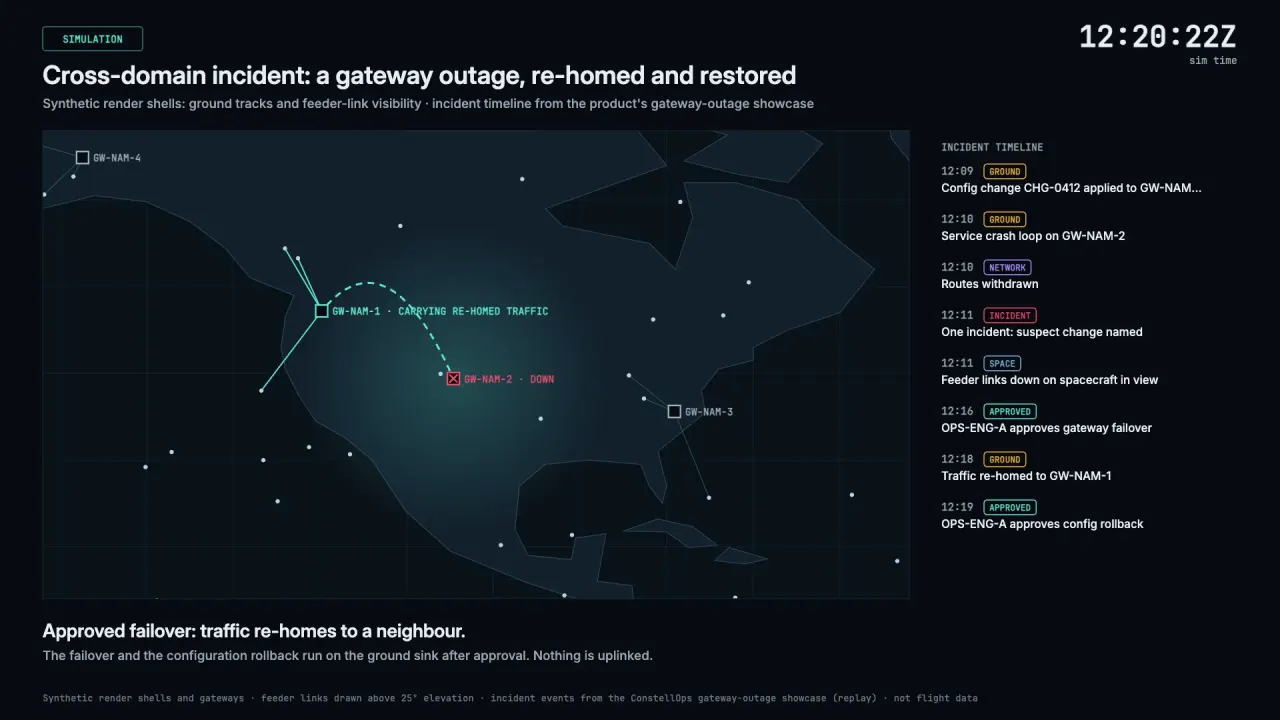
What this shows
Simulation. A configuration change takes a gateway down, and ground, network and space symptoms follow within minutes. They are joined into one incident. After approval, traffic re-homes to a neighbouring gateway and the change is rolled back on the ground. Nothing is uplinked.Ground outage. Tickets everywhere.
Ground-software and configuration faults can take service down while every spacecraft is healthy.
The full picture
Flight-operations tooling and network-operations tooling are separate stacks whose events are not joined, so one cause becomes three tickets, three on-call engineers and a slower recovery.
How ConstellOps handles it
- 01Join
- 02Diagnose read-only
- 03Runbook as procedure
- 04Ground stays on the ground
- 05Close with a record
Each step in full
- 01JoinSpacecraft alarms, gateway and ground-software health, and link and routing state arrive as untrusted data. The triage and network-incident agents join them into one incident.
- 02Diagnose read-onlyDiagnostics run at A0: no side effects and no approval needed.
- 03Runbook as procedureEach remediation step, such as a gateway failover or a configuration rollback, is a proposal that passes the gates and waits for approval.
- 04Ground stays on the groundGround-only actions execute on the ground and never reach the uplink path. Spacecraft follow-ups go to the FDIR agent (fault detection, isolation and recovery).
- 05Close with a recordThe incident closes with a customer-impact summary and its signed decision records.
Look freely. Change nothing without approval.
Autonomy level and approvals
Diagnostics are A0. Remediation is A1: a person approves every change.
Measured on v1.0.0rc4.
Full results table and notes
Gateway outages across space, ground and network on ConstellOps v1.0.0rc4: 16 of 20 runs; the product refused 4 at start. The partially matched classical comparison follows the table.
| Metric | ConstellOps |
|---|---|
| Runs completed | 16 of 20 (4 refused at start) |
| Mean time to detect | about 1.0 min |
| Time to restore, mean | 15 min |
| Capacity kept during the incident | 0.824 (about 82%, synthetic network model) |
| Customer service lost per incident | 270,000 subscriber-minutes |
| Commands sent to spacecraft | 0 (ground-only remediation) |
| Human sign-offs required per run (by policy) | 2.38 |
See it in the operations console
Operations console · Cross-domain incidentsReplay
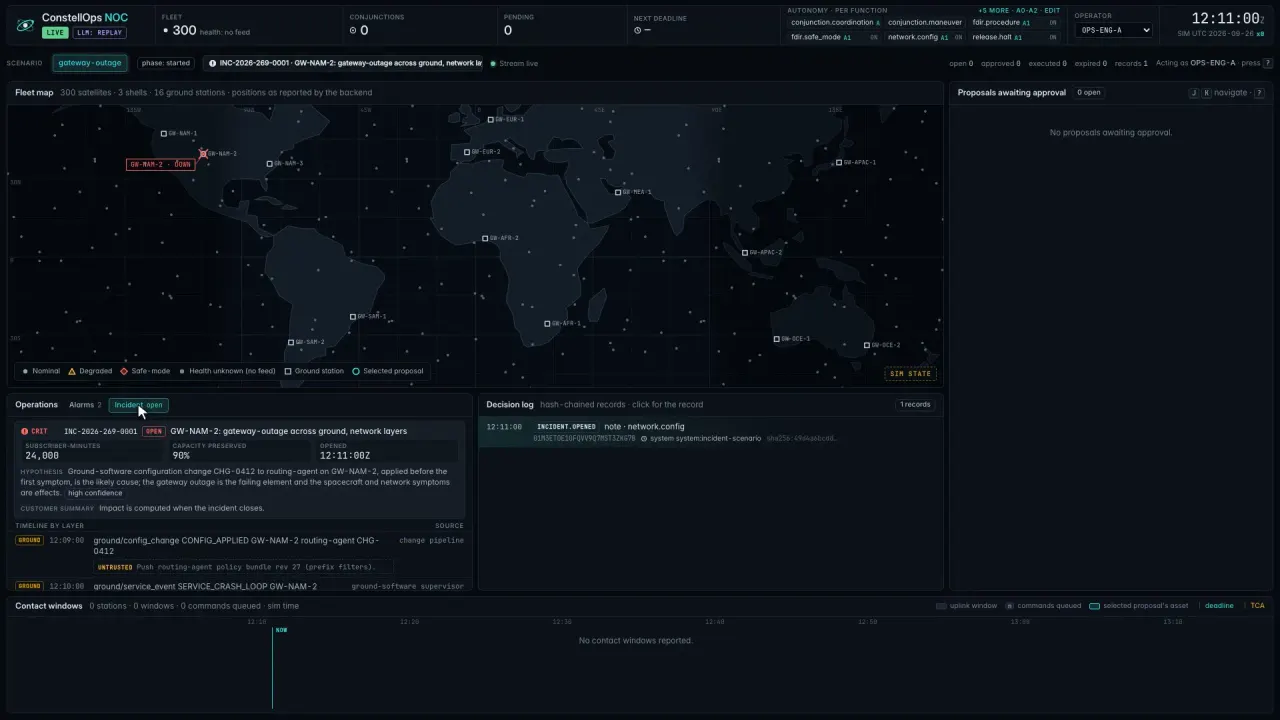
What this shows
Events on three layers become one incident. Failover and a configuration rollback run on the ground after approval and are never uplinked.More console captures
Operations console · Cross-domain incidentsReplay
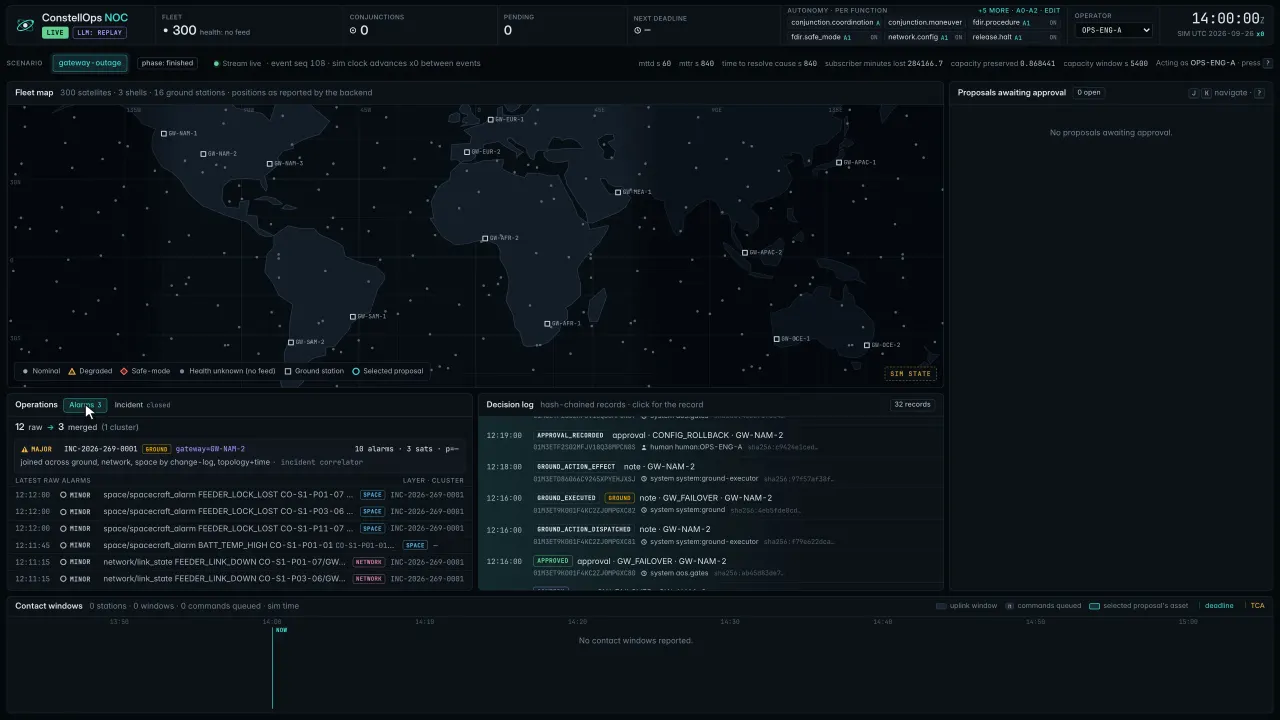
What this shows
The joined events count as one incident; an unrelated event stays separate.Operations console · Cross-domain incidentsReplay
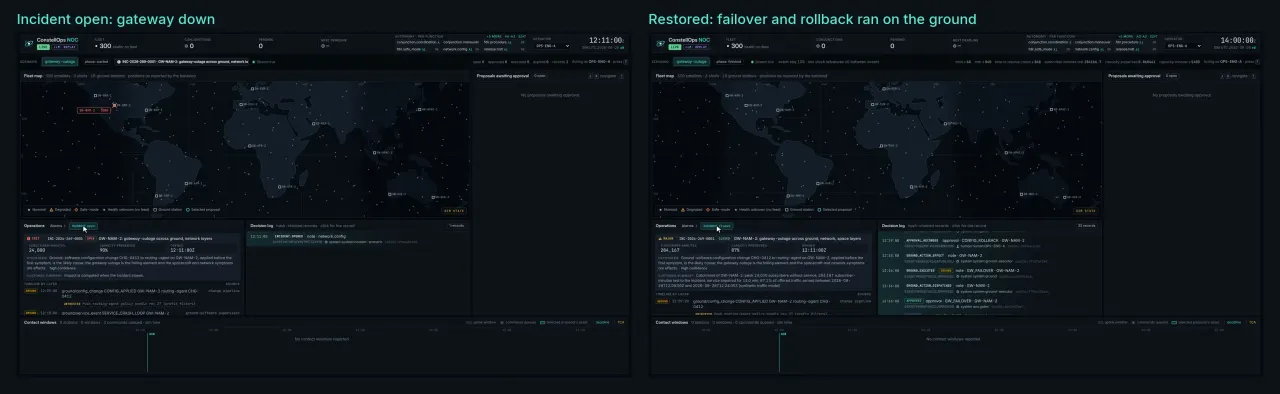
What this shows
The incident open, and the gateway restored after two approved ground actions.Operations console · Cross-domain incidentsReplay
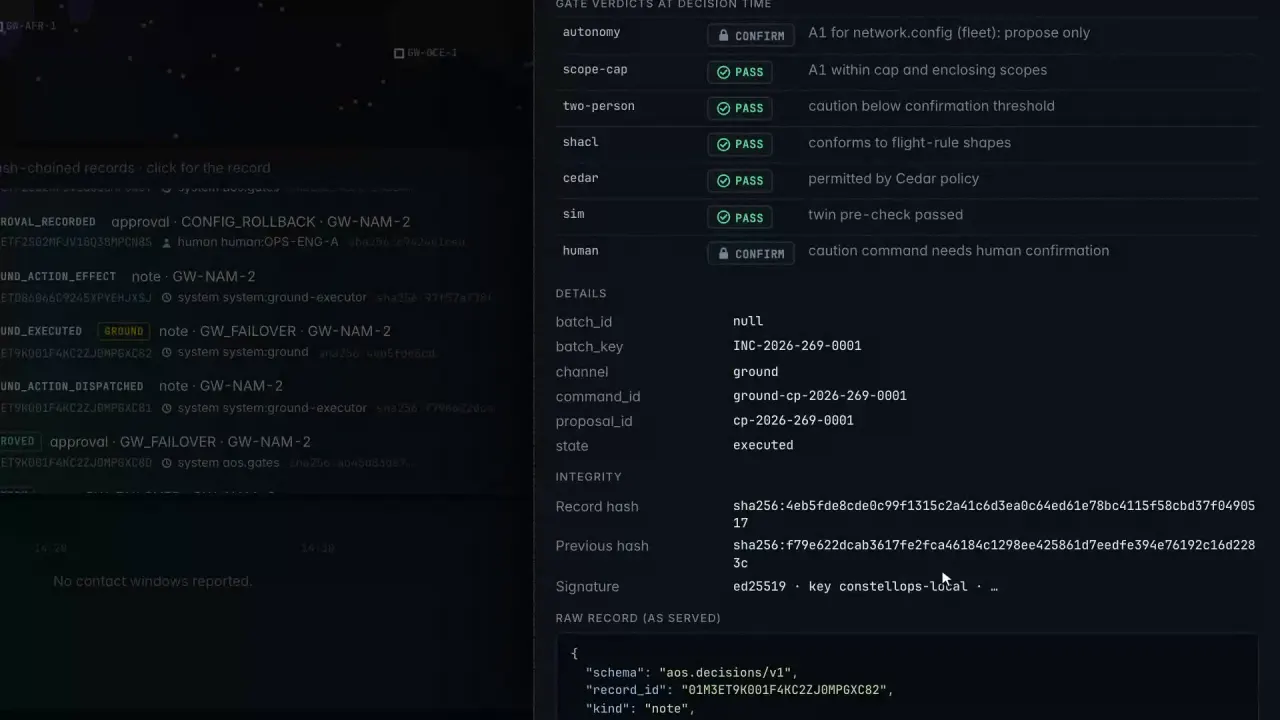
What this shows
The signed ground-execution record for the approved failover: provenance, approver, gate verdicts and the integrity block.Operations console · Cross-domain incidentsReplay
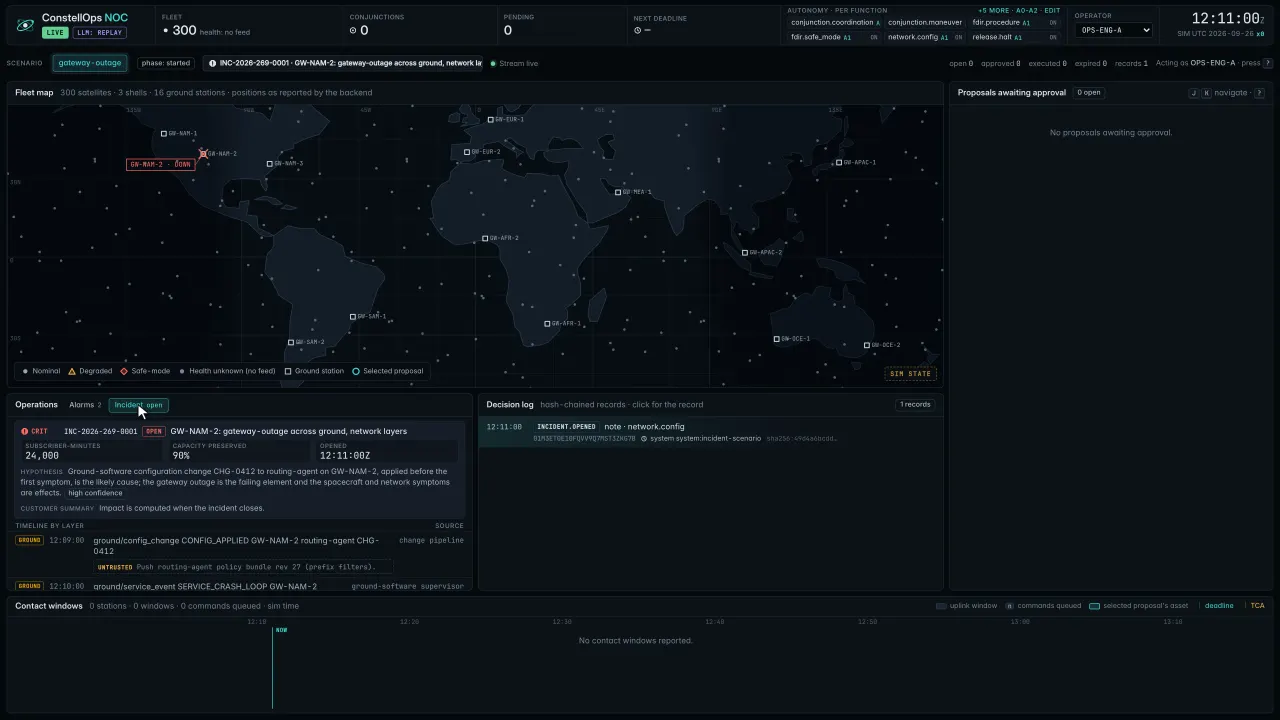
What this shows
One incident across ground, network and space, with the suspect change named and a stated hypothesis.Operations console · Cross-domain incidentsReplay
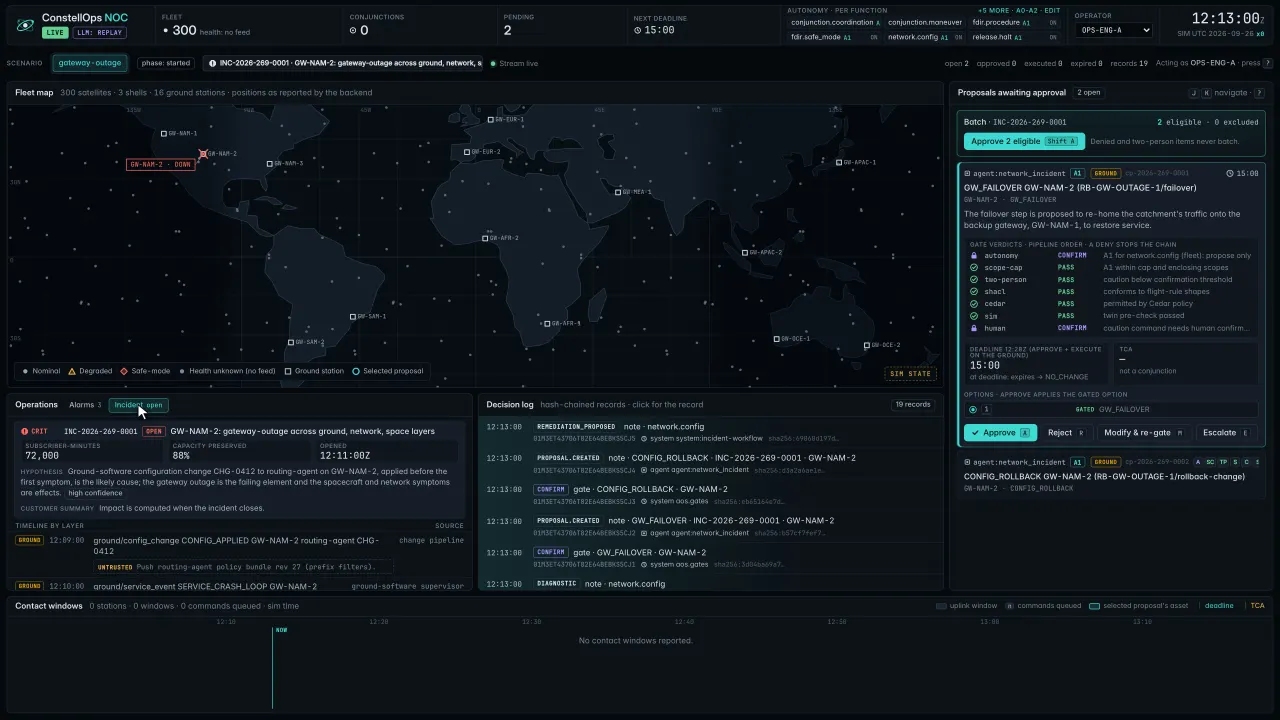
What this shows
The network-incident agent proposes a gateway failover and a configuration rollback: gated, ground-only, awaiting approval.Operations console · Cross-domain incidentsReplay
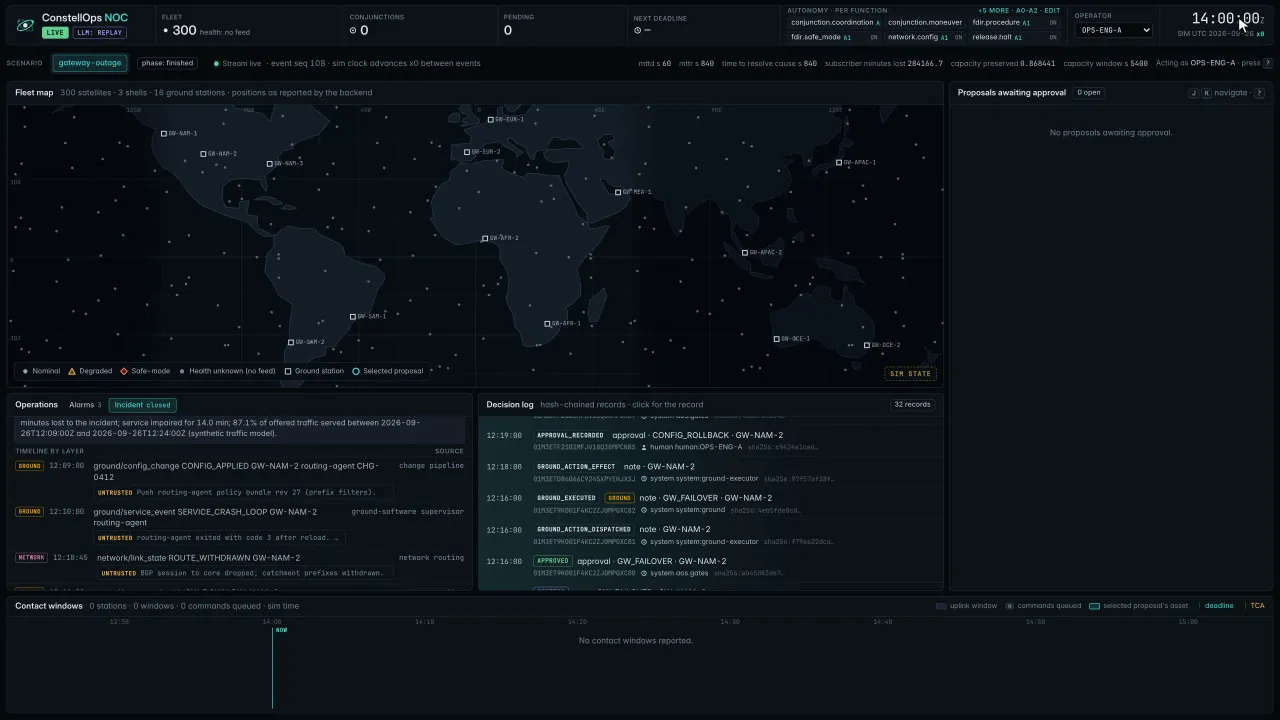
What this shows
Third-party text stays in labelled, inert 'untrusted' boxes in the incident timeline.What it is not
Not a replacement for data-plane routing or beam scheduling.
The limits, listed
- Not a replacement for data-plane routing or beam scheduling.
- Not tied to one ticketing product.
- Not customer communications.