
Use case · Fleet anomaly triage
Name the bad build behind a fleet-wide fault.
Names the shared build behind a fleet-wide fault: right in 19 of 20 runs, still slow.
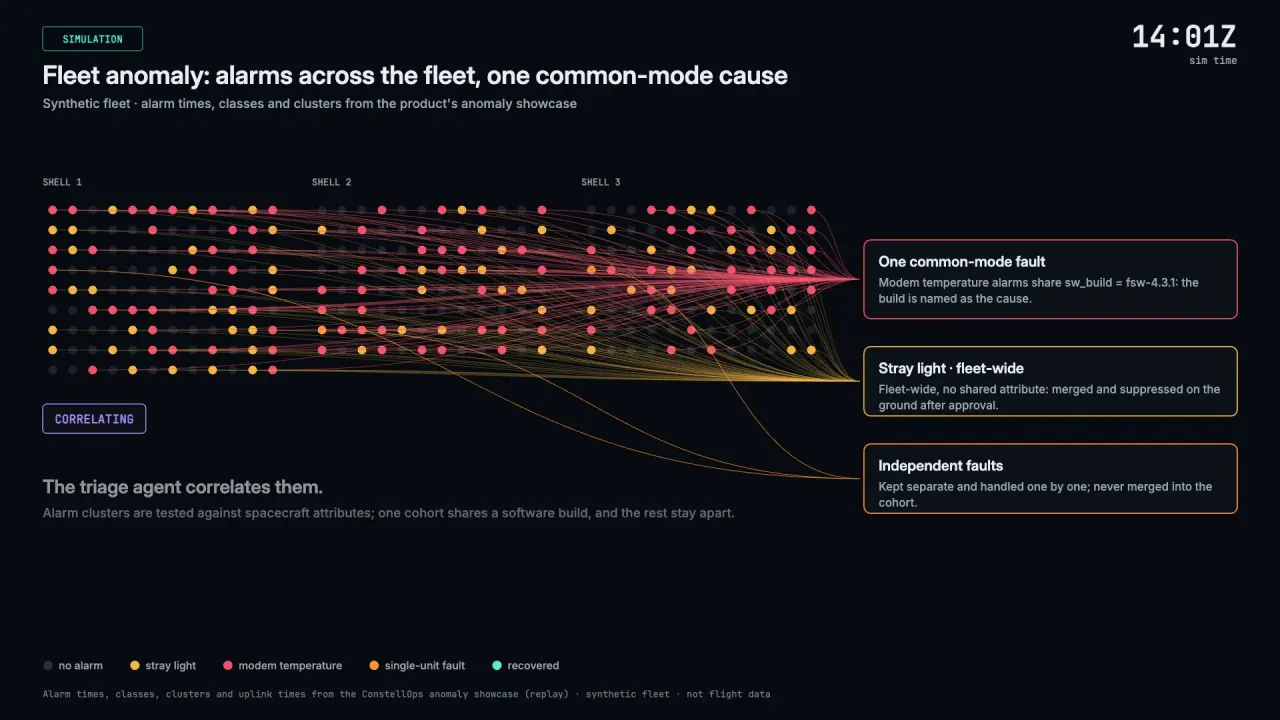
What this shows
Simulation. Alarms arrive across the whole fleet, with stray light on many spacecraft, modem temperature on others and a few single faults. The triage agent tests the clusters against spacecraft attributes, names one shared software build as the common-mode cause and keeps the rest apart. The recovery, approved as a batch, is uplinked spacecraft by spacecraft.Alarms grow with the fleet. Attention does not.
Operators work out-of-limit alarms one satellite at a time.
The full picture
Static limits produce benign repeat alarms that get muted, and muting hides real signals. The daily cost is confirming that nothing is wrong. And a fault shared by dozens of satellites from one build is invisible when each satellite is triaged alone.
How ConstellOps handles it
- 01Detect
- 02Reduce
- 03Correlate
- 04Explain and propose
- 05Approve once, uplink per satellite
Each step in full
- 01DetectTelemetry and alarms stream in as untrusted data; verified detector tools flag anomalies.
- 02ReduceThe triage agent proposes merging and suppressing benign repeats. These are ground-side actions only, and the triage agent can never command a spacecraft.
- 03CorrelateThe FDIR agent (fault detection, isolation and recovery) groups anomalies by hardware lot, software build and shell from the fleet registry.
- 04Explain and proposeIt writes a short triage narrative with a root-cause class and proposes a safe action for the cohort (the group of satellites that share the cause).
- 05Approve once, uplink per satelliteOne reviewed decision covers the correlated group; each recovery still passes the gates and uplinks in its own contact window.
Ground-side housekeeping, spacecraft-side approval.
Autonomy level and approvals
Triage is A0 (observe and explain) for any spacecraft command: it can never command. Merging and suppressing alarms on the ground is designed for A2 (run pre-approved procedures) and runs at A1 (propose; a person approves) until the SDK's veto window ships. FDIR recoveries are A1: a person approves each one.
Measured on v1.0.0rc4, losses included.
Full results table and notes
20 runs of a common-mode fault from a bad software build on ConstellOps v1.0.0rc4, with an automated stand-in operator that approves every proposal. The matched classical comparison follows the table.
| Metric | ConstellOps (automated stand-in operator) |
|---|---|
| Correct bad build identified | 19 of 20 |
| Related alarms grouped with the right cause | 0.95 (automated stand-in operator) |
| Time to identify the common cause | 46.25 h (about 46 h, automated stand-in operator) |
| Alarm volume | +0.06% (slight increase) |
| Unsafe commands sent, 19 runs that replay identically | 0 of 777 (19 reproducible runs) |
| Unsafe commands sent, the one run that did not reproduce | 0 of 37 |
| Runs that replay identically | 19 of 20 (misses the 100% target) |
| Human sign-offs required per run (by policy) | 43.55 |
See it in the operations console
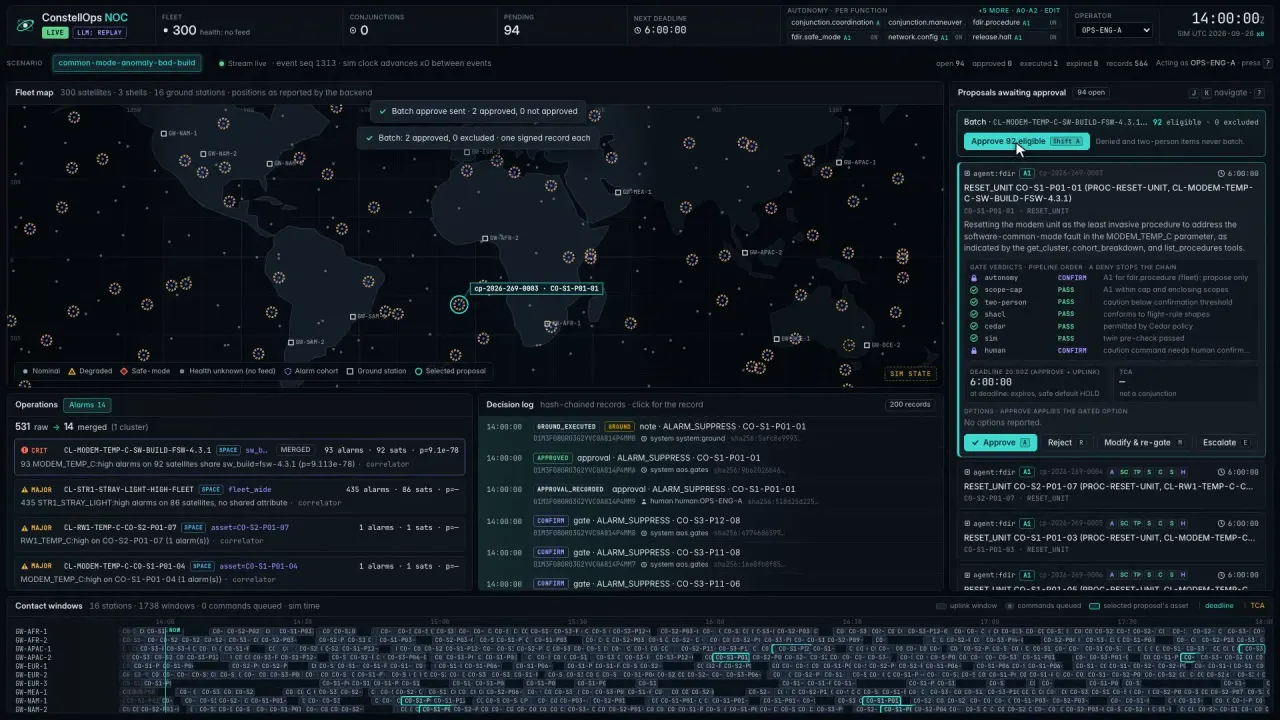
What this shows
Alarms are grouped by cause. The bad-build group is named, and recoveries uplink through the gates.More console captures
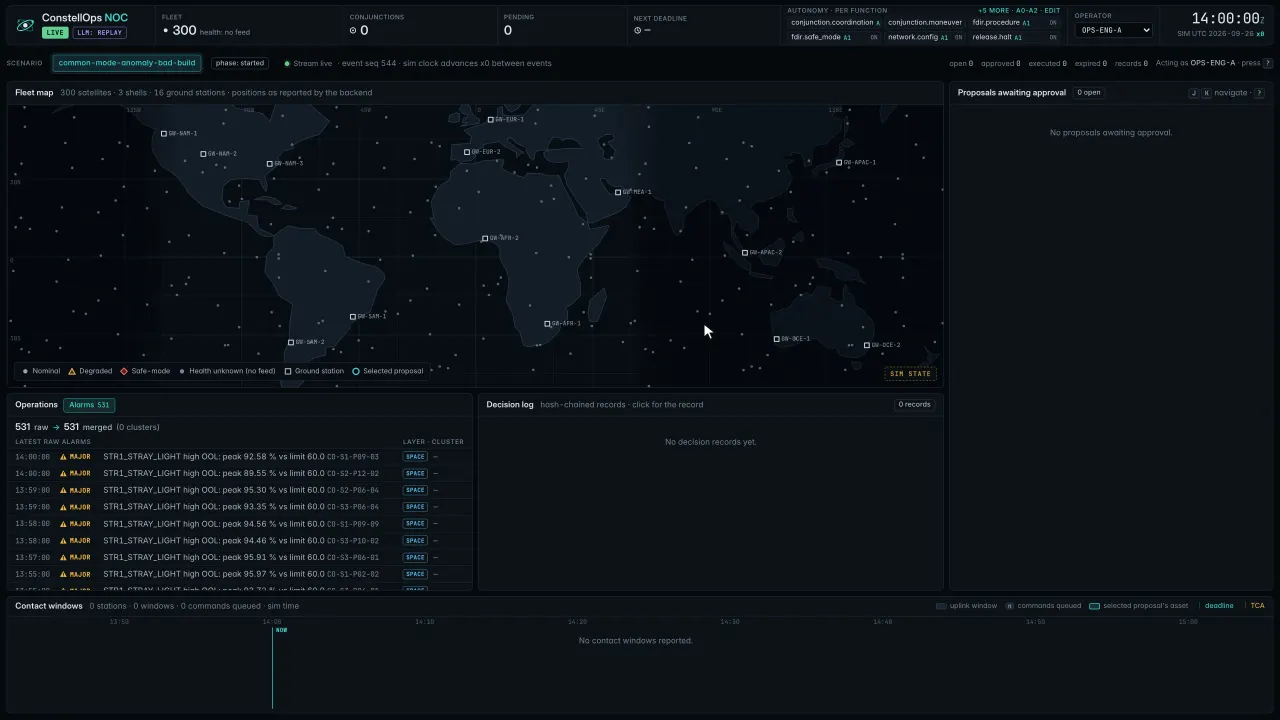
What this shows
Before correlation: hundreds of confirmed limit alarms across the fleet.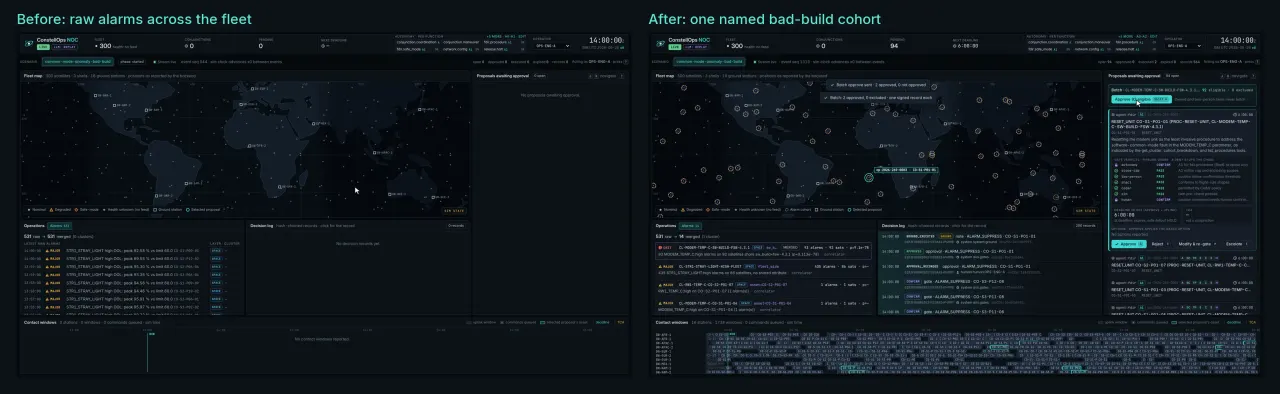
What this shows
Before and after correlation: the raw alarm flood and the merged, named cohort.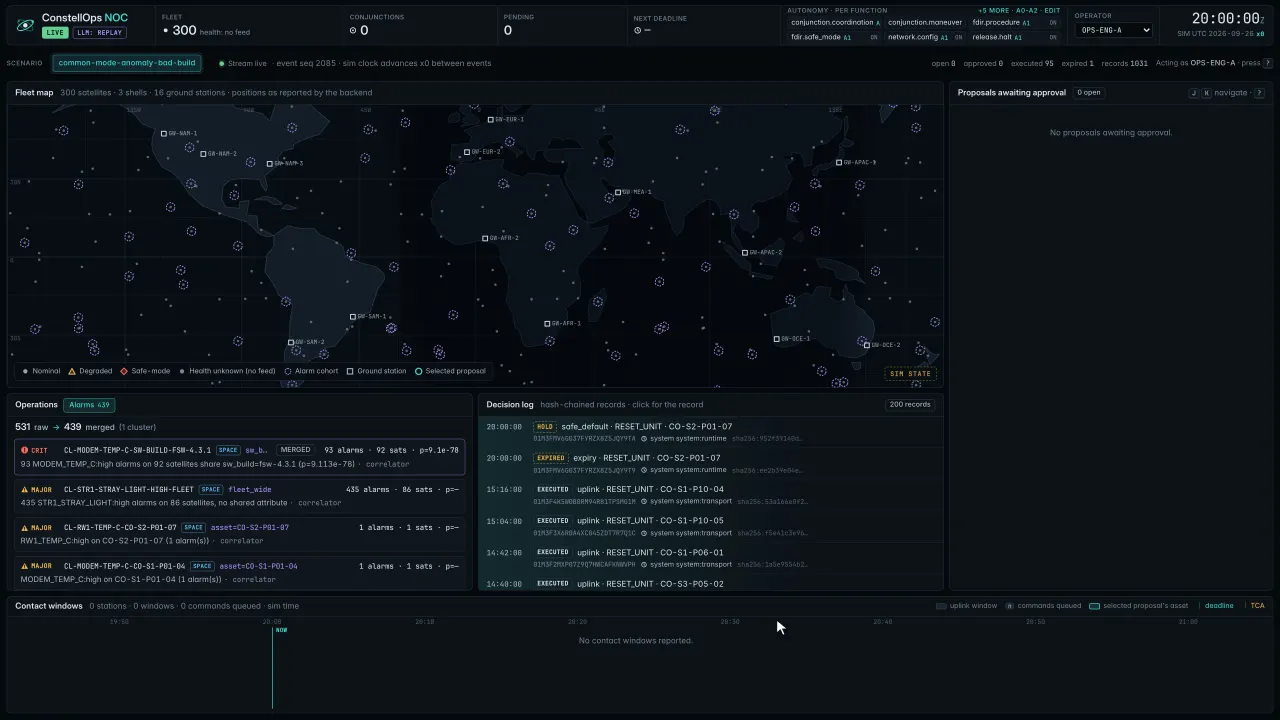
What this shows
An open item that reached its deadline: expired with its default action, HOLD; nothing sent, and the expiry is flagged in the console.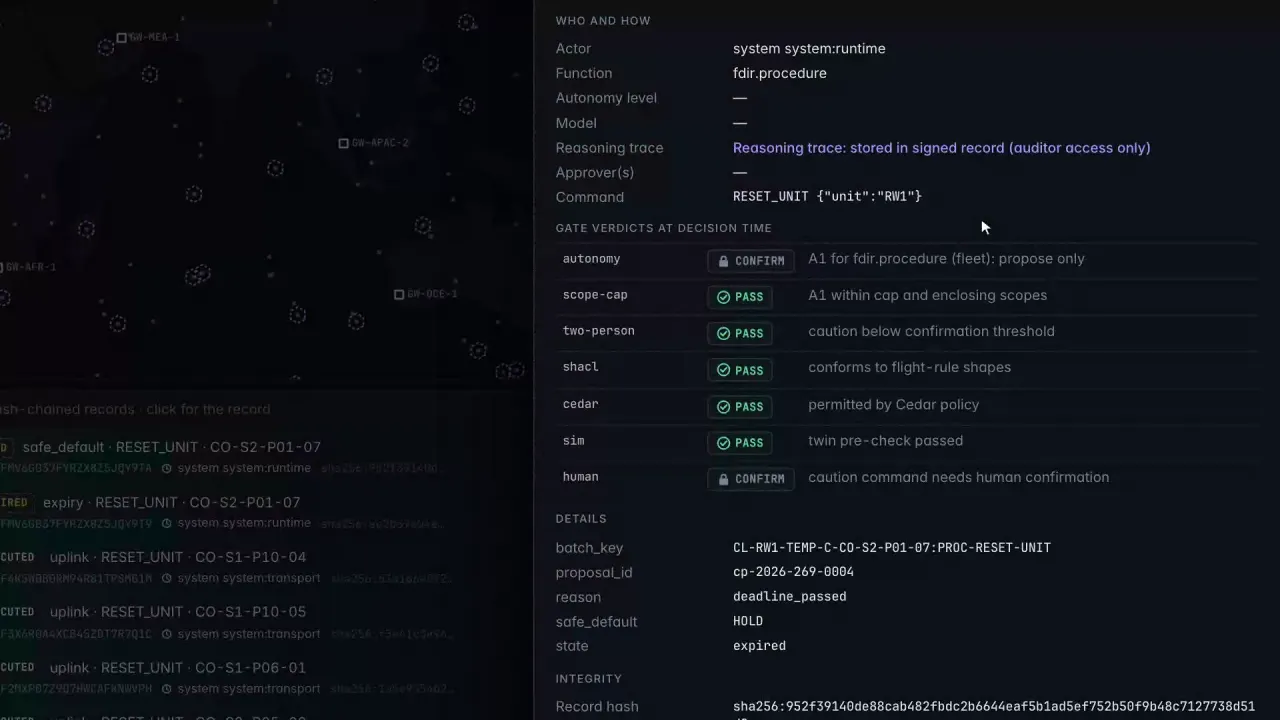
What this shows
An item nobody approved reaches its deadline and expires with its default action. Nothing is sent, the expiry is flagged in the console, and the expiry is itself a signed record.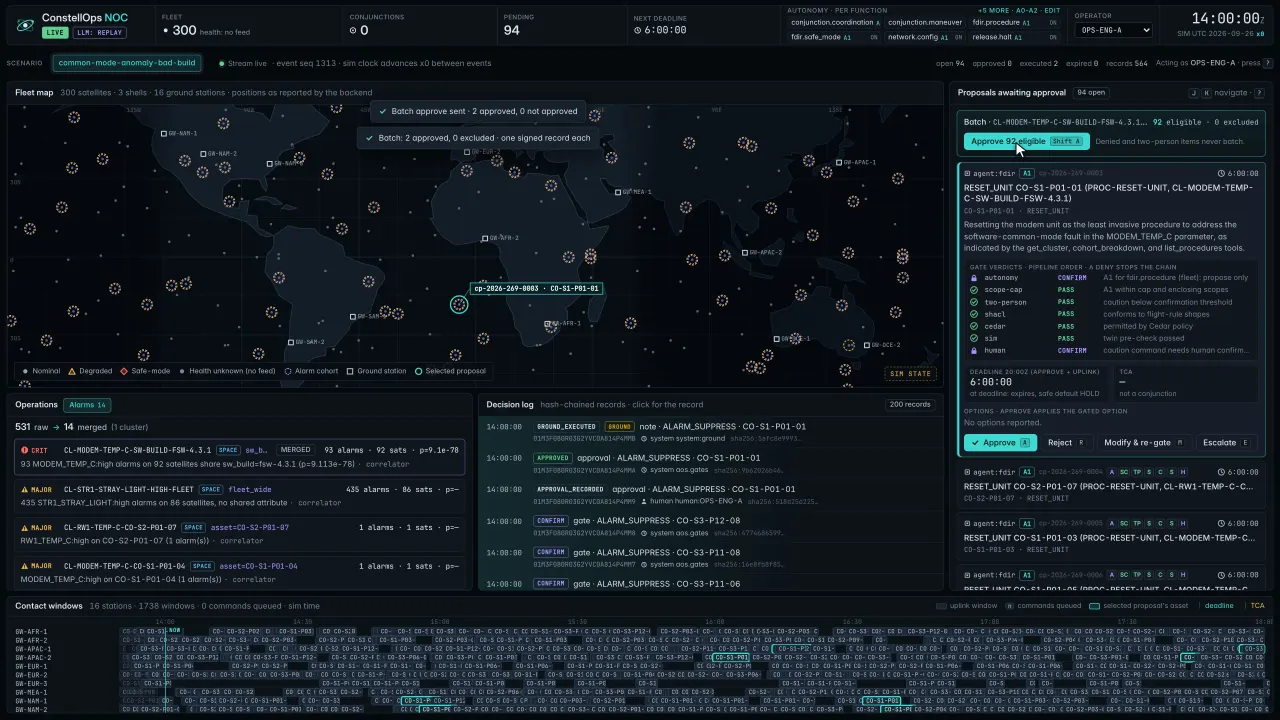
What this shows
After an approved ground-side merge, raw alarms collapse to a short list, and the bad-build cohort is named.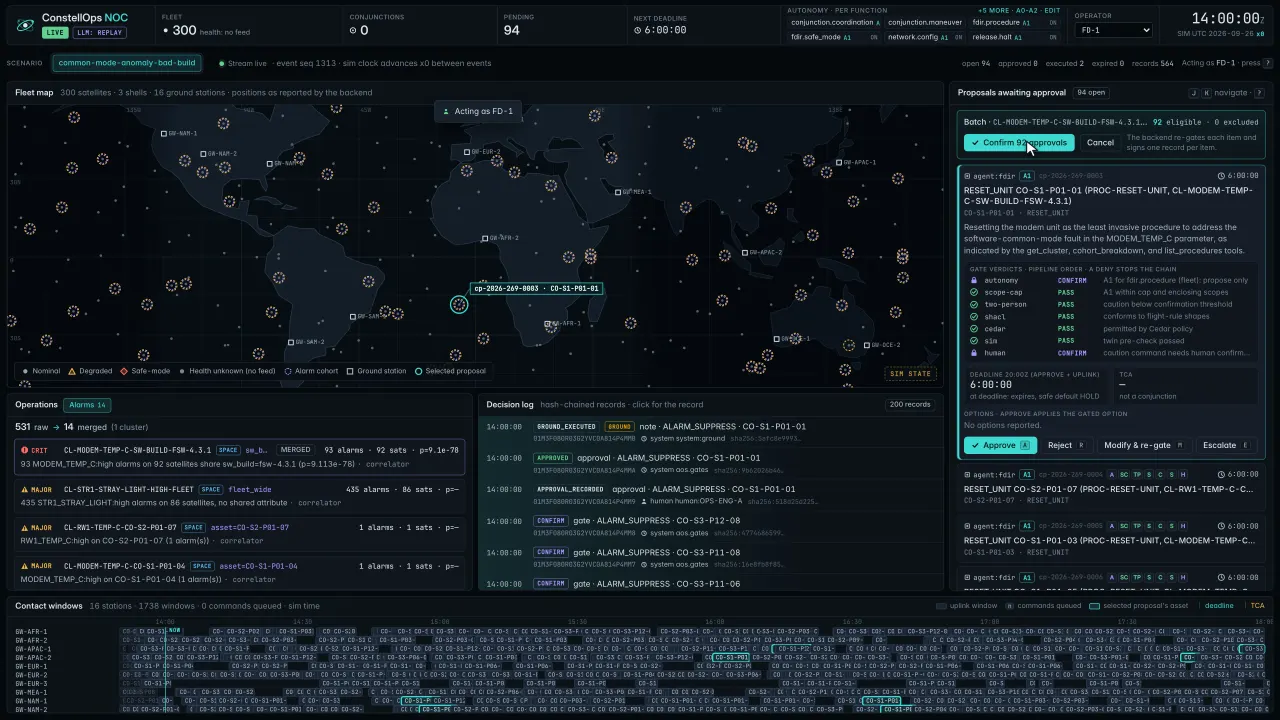
What this shows
The flight director confirms the common-mode recovery batch: one unit reset per affected spacecraft, each re-gated and signed.What it is not
Not a replacement for onboard FDIR. It works the ground side.
The limits, listed
- Not a replacement for onboard FDIR. It works the ground side.
- Not autonomous commanding by the triage agent.
- Not a detector-training product. Detectors are tools it evaluates and uses.