
← All use cases

Use case · Staged flight-software rollout

A bad build halts itself at the canary.

Canary first, then waves. A regression halts it; your approvers own rollback.

Rollout wavescanary → waves · halt on regression
CANARYWAVE 1WAVE 2WAVE 3HALT · ROLLBACK
Illustrative · synthetic fleet · no figures
Simulation · Staged rolloutsSimulation
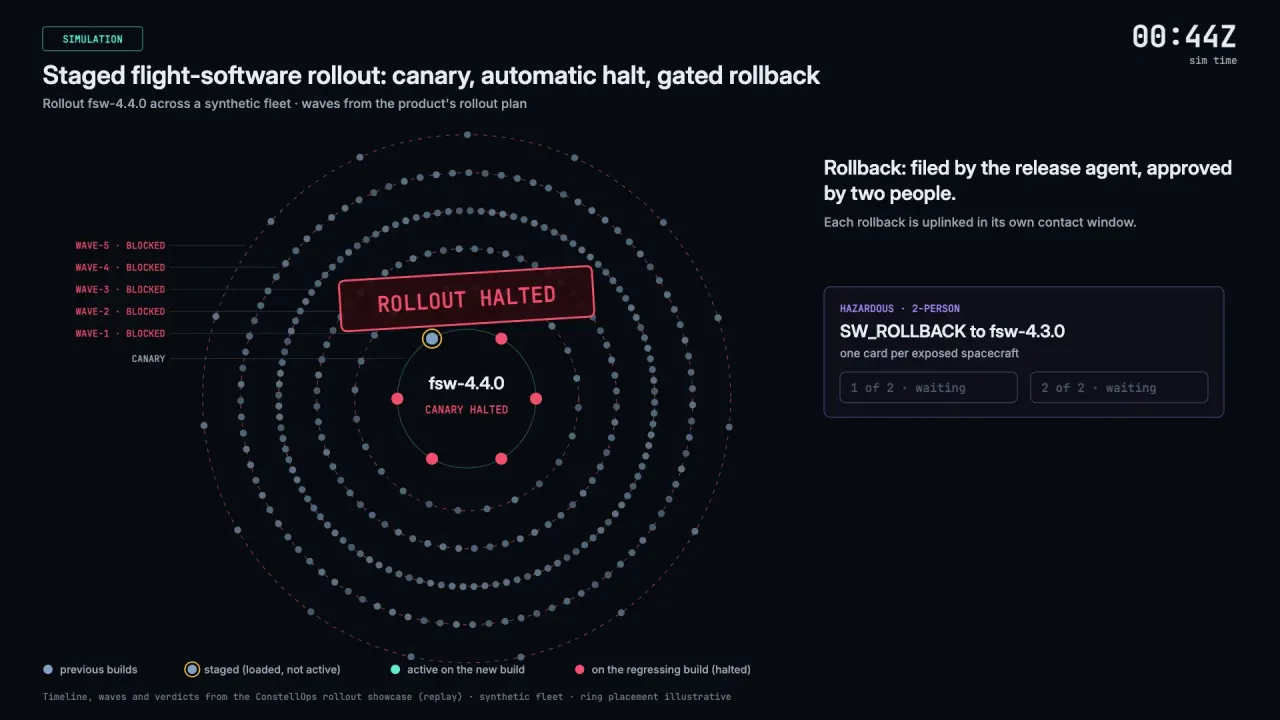
What this showsSimulation. A new flight-software build goes to a small canary first. Each activation needs two different approvers. The canary comparator finds a regression and halts at once, every later wave stays blocked, and the rollback, also approved by two people, returns each exposed spacecraft to its previous build.
Simulation render · synthetic constellation [clip 1]

Frequent releases. Fleet-wide blast radius.

Large fleets ship flight and ground software often, and a fleet-wide regression is a single point of failure.

The full picture

The discipline that protects a web service (staging, blast-radius limits, pre-deploy verification, fast rollback) is harder in orbit, where every upload waits for a contact window.

How ConstellOps handles it

Procedure
  1. 01
    Plan
  2. 02
    Verify
  3. 03
    Upload by approval
  4. 04
    Halt automatically
  5. 05
    Roll back
Each step in full
Procedure, in full
  1. 01
    PlanThe release agent builds a canary cohort and waves from the fleet registry.
  2. 02
    VerifyThe build is checked against the digital twin before any upload. A build that fails is blocked.
  3. 03
    Upload by approvalCanary upload and each promotion are proposals approved by the Flight Director and uplinked in contact windows. Activation and rollback are hazardous commands: two distinct approvers.
  4. 04
    Halt automaticallyCanary health is compared with the fleet. On regression, the rollout halts before the next wave. The halt only stops promotion; it never uplinks a command on its own.
  5. 05
    Roll backRollback is proposed and approved like any other command.

Automatic in the safe direction only.

Autonomy level and approvals

Promotion and rollback are A1. The automatic halt is fail-safe: it can only stop a rollout, never advance one.

A bad build stopped after about five satellites.

20 of 20

bad rollouts halted
ⓘ

How it was measured

5

satellites on the bad build
ⓘ

How it was measured

Full results table and notes

20 staged rollouts of a build with a canary regression on ConstellOps v1.0.0rc4. No matched classical comparison exists for rollouts.

Staged rollouts results
MetricConstellOps
Bad-build rollouts halted before the full fleet20 of 20
Canary wave size6
Satellites on the bad build before the halt5
Time from first install to halt0.45 h (about 27 min)
Rollouts where the bad build went beyond the canary0 of 20
Unsafe uplinks, with two distinct approvers on every software activate and rollback0 of 306
Runs that replay identically20 of 20
Human sign-offs required per run (by policy; two-person actions count twice)27.4

See it in the operations console

Operations console · Staged rolloutsReplay
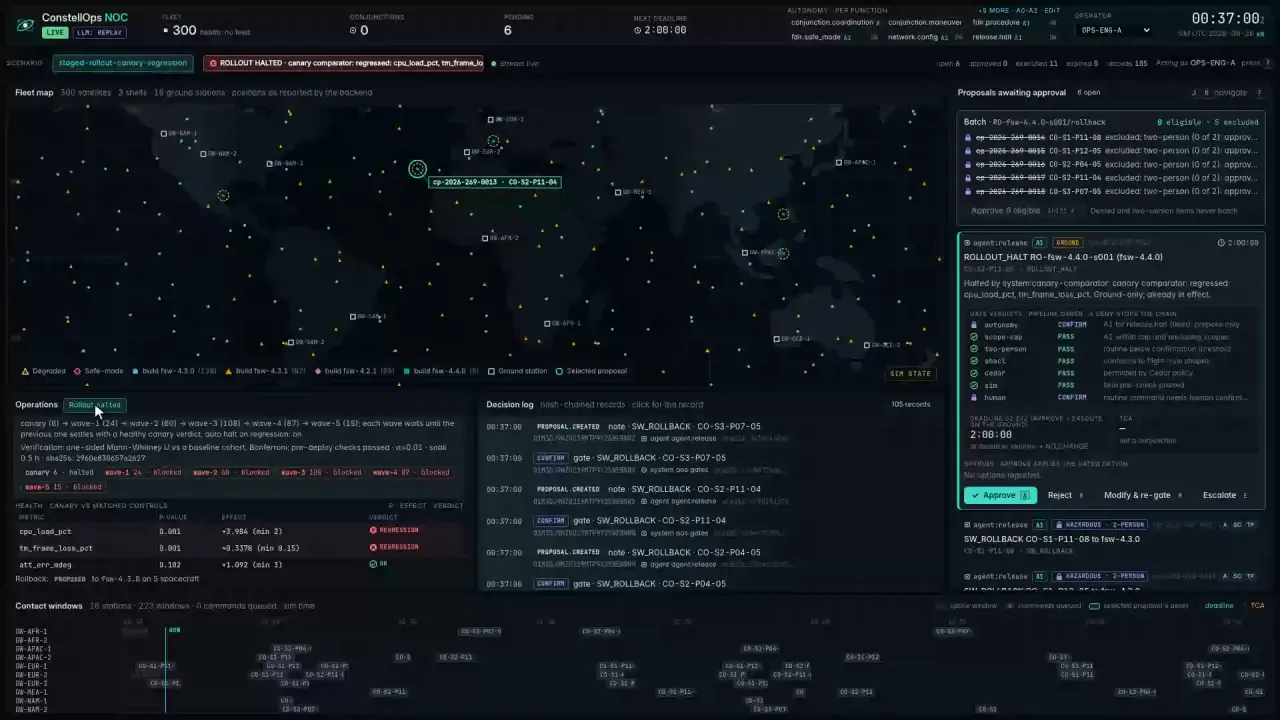
What this showsThe canary comparator halts the build. The rollback is approved under two distinct approver ids and uplinked in contact windows.
Recorded replay · demonstration, not a benchmark [clip 2]Map positions illustrative [map 3]
More console captures
Operations console · Staged rolloutsReplay
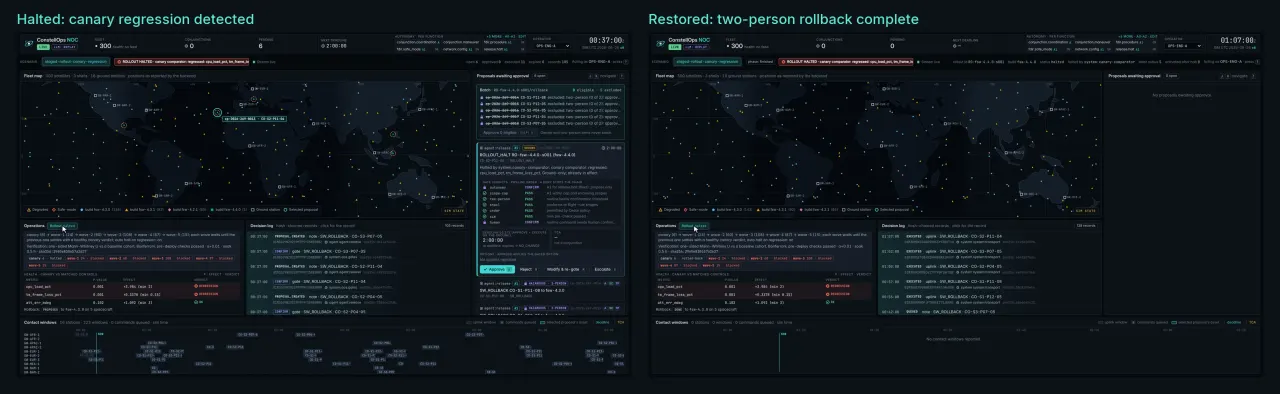
Before and after: the halt at the canary stage and the restored fleet after the gated rollback.
What this showsBefore and after: the halt at the canary stage and the restored fleet after the gated rollback.
Recorded replay · demonstration, not a benchmark [clip 2]Map positions illustrative [map 3]
Operations console · Staged rolloutsReplay
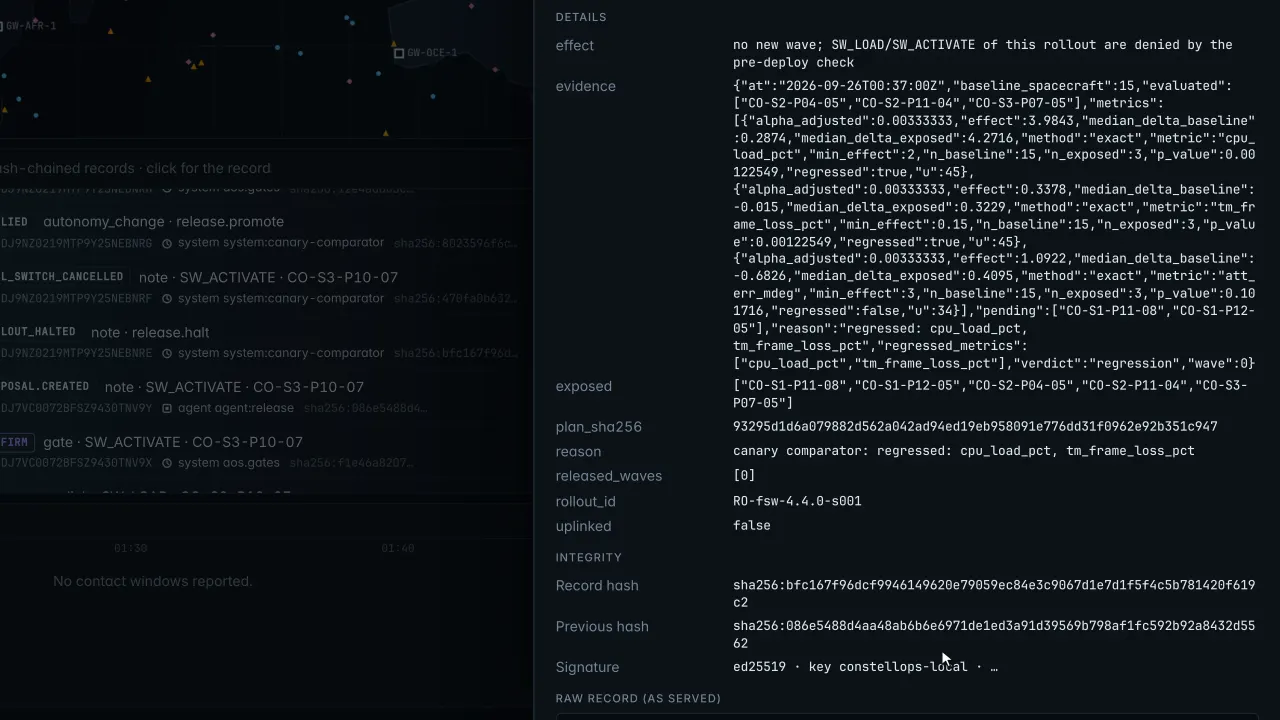
The signed rollout_halted record: evidence, exposed spacecraft, record hash, previous hash and Ed25519 signature.
What this showsThe signed rollout_halted record: evidence, exposed spacecraft, record hash, previous hash and Ed25519 signature.
Recorded replay · demonstration, not a benchmark [clip 2]Map positions illustrative [map 3]
Operations console · Staged rolloutsReplay
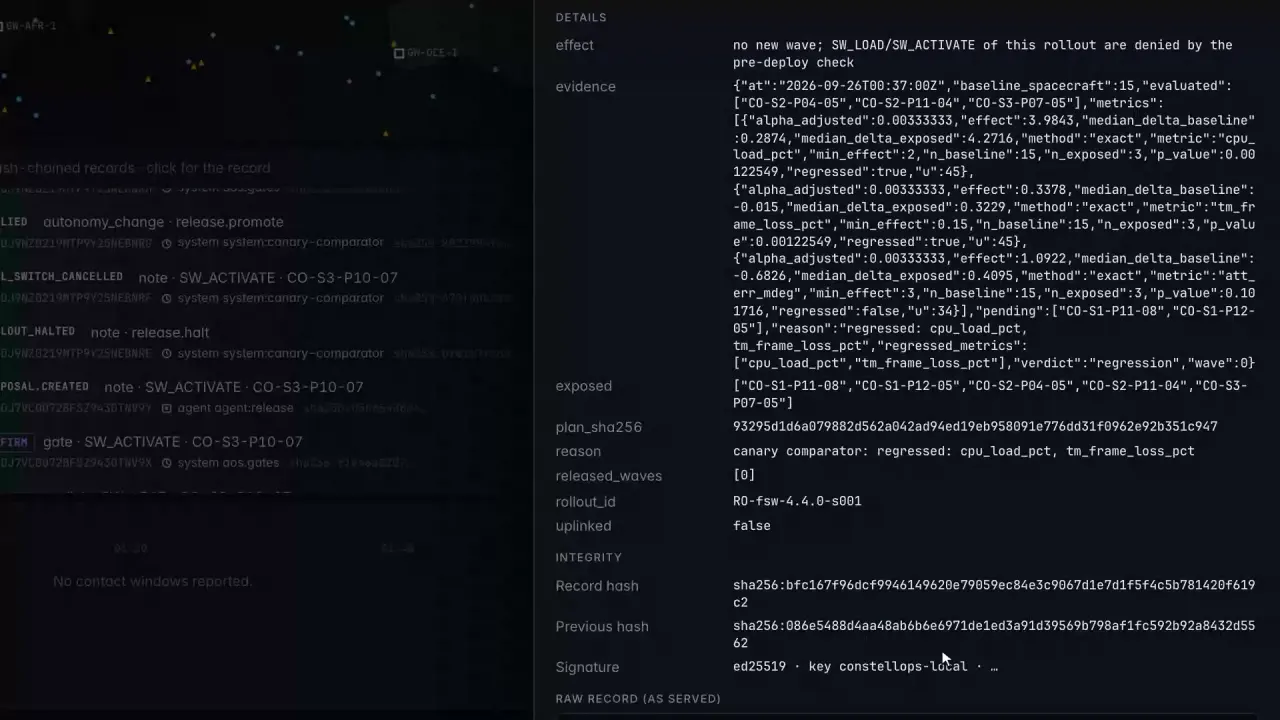
What this showsThe rollout-halted decision record, written by the canary comparator: evidence, exposed spacecraft, and an integrity block with record hash, previous hash and Ed25519 signature.
Recorded replay · demonstration, not a benchmark [clip 2]Map positions illustrative [map 3]
Operations console · Staged rolloutsReplay
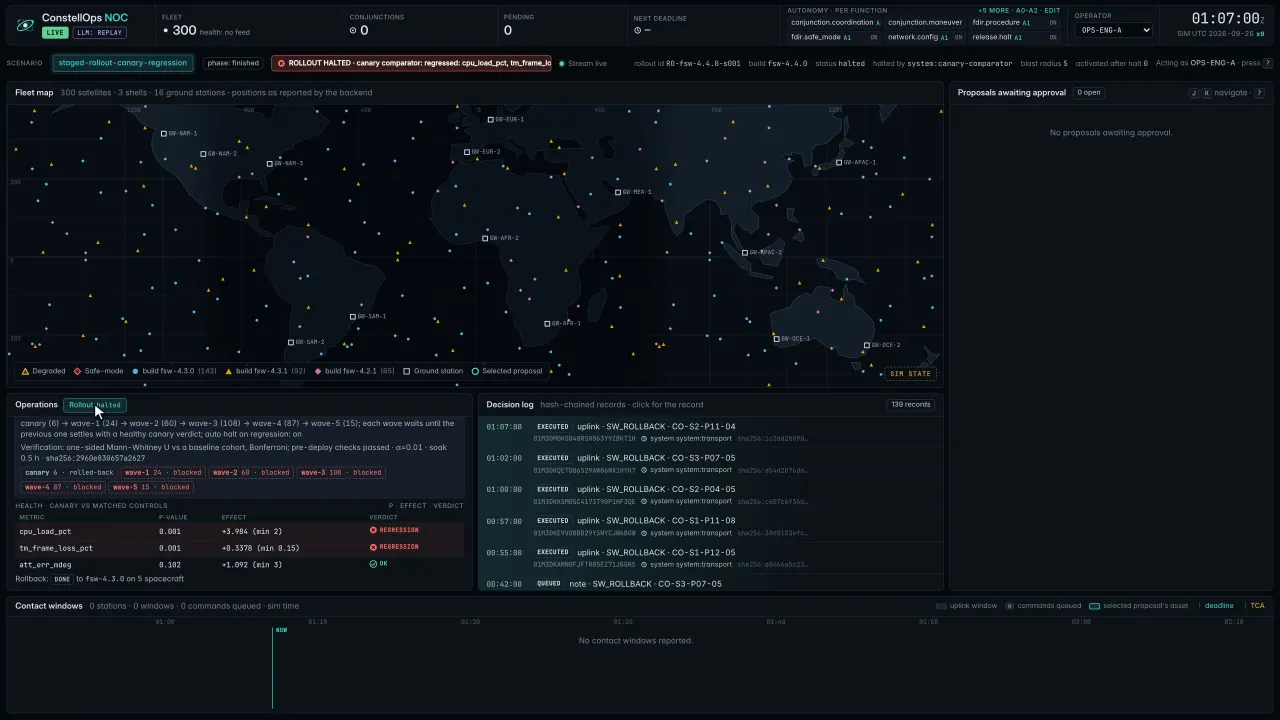
Rollback complete: every exposed spacecraft back on its previous build.
What this showsRollback complete: every exposed spacecraft back on its previous build.
Recorded replay · demonstration, not a benchmark [clip 2]Map positions illustrative [map 3]
Operations console · Staged rolloutsReplay
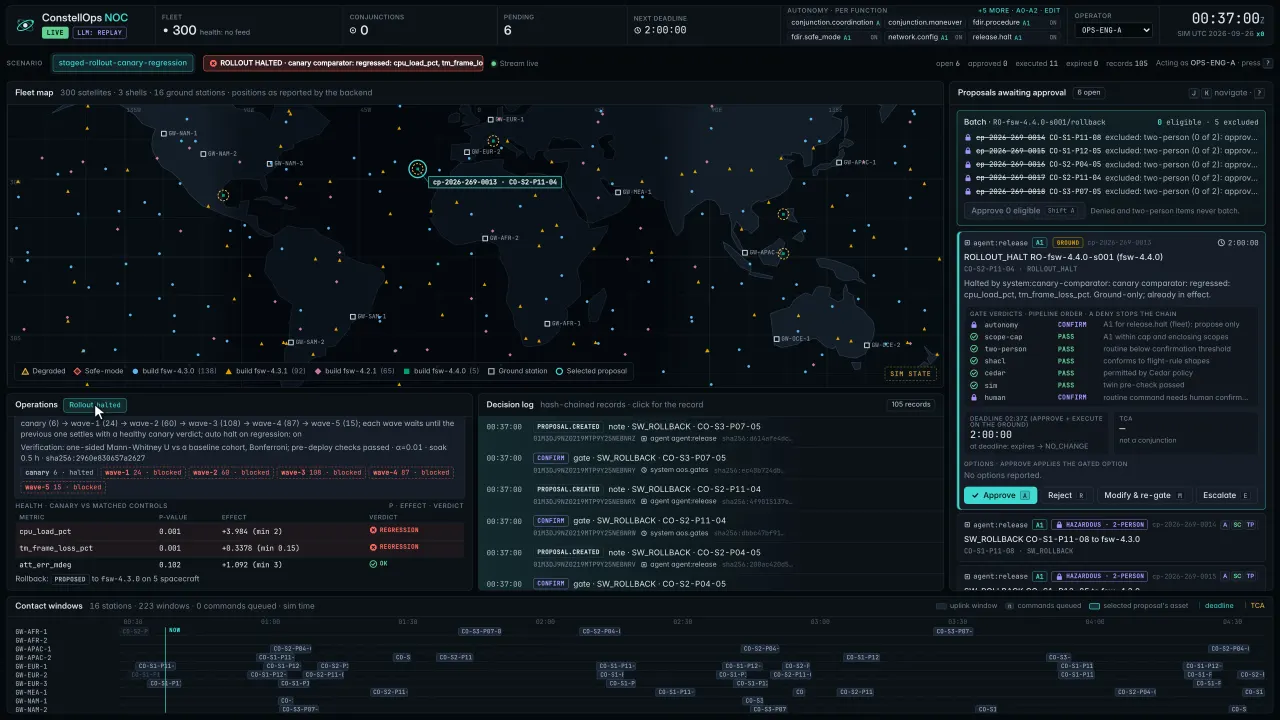
The canary comparator has halted the rollout: regressed health metrics, later waves blocked, rollback proposed.
What this showsThe canary comparator has halted the rollout: regressed health metrics, later waves blocked, rollback proposed.
Recorded replay · demonstration, not a benchmark [clip 2]Map positions illustrative [map 3]
Operations console · Staged rolloutsReplay
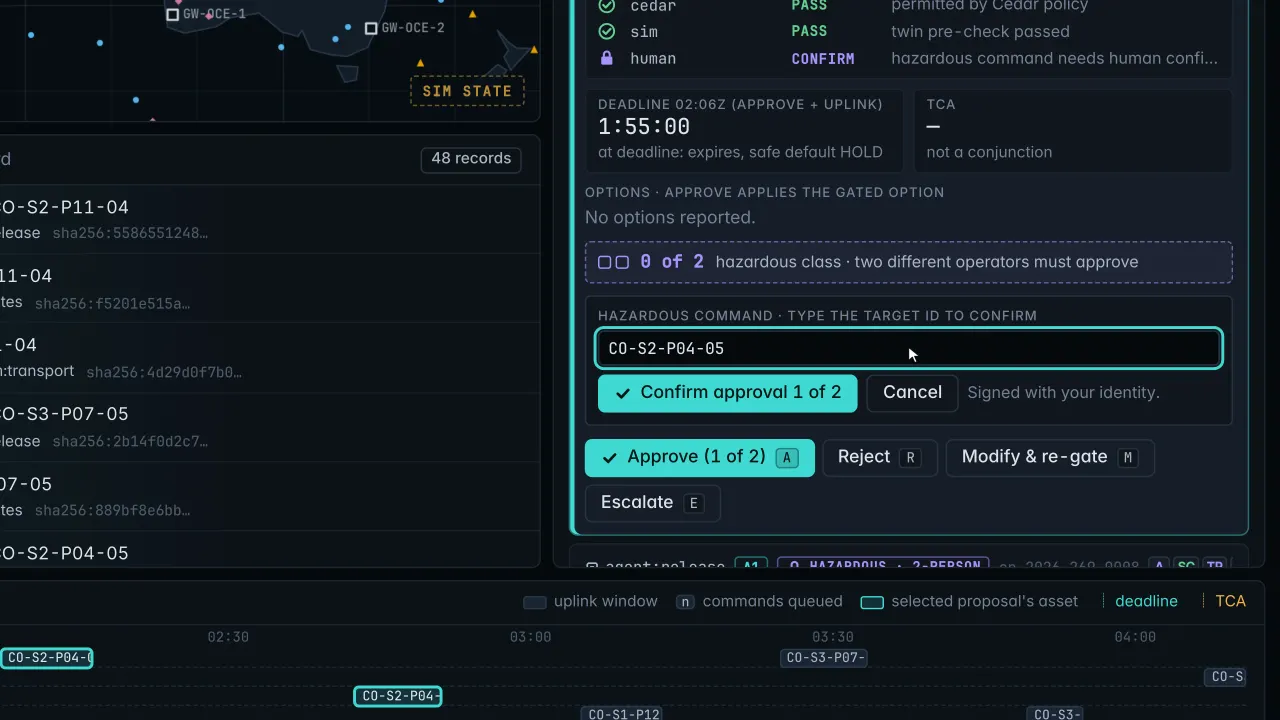
Two-person rule, first approver: FD-1 types the target spacecraft ID to confirm approval 1 of 2.
What this showsTwo-person rule, first approver: FD-1 types the target spacecraft ID to confirm approval 1 of 2.
Recorded replay · demonstration, not a benchmark [clip 2]Map positions illustrative [map 3]
Operations console · Staged rolloutsReplay
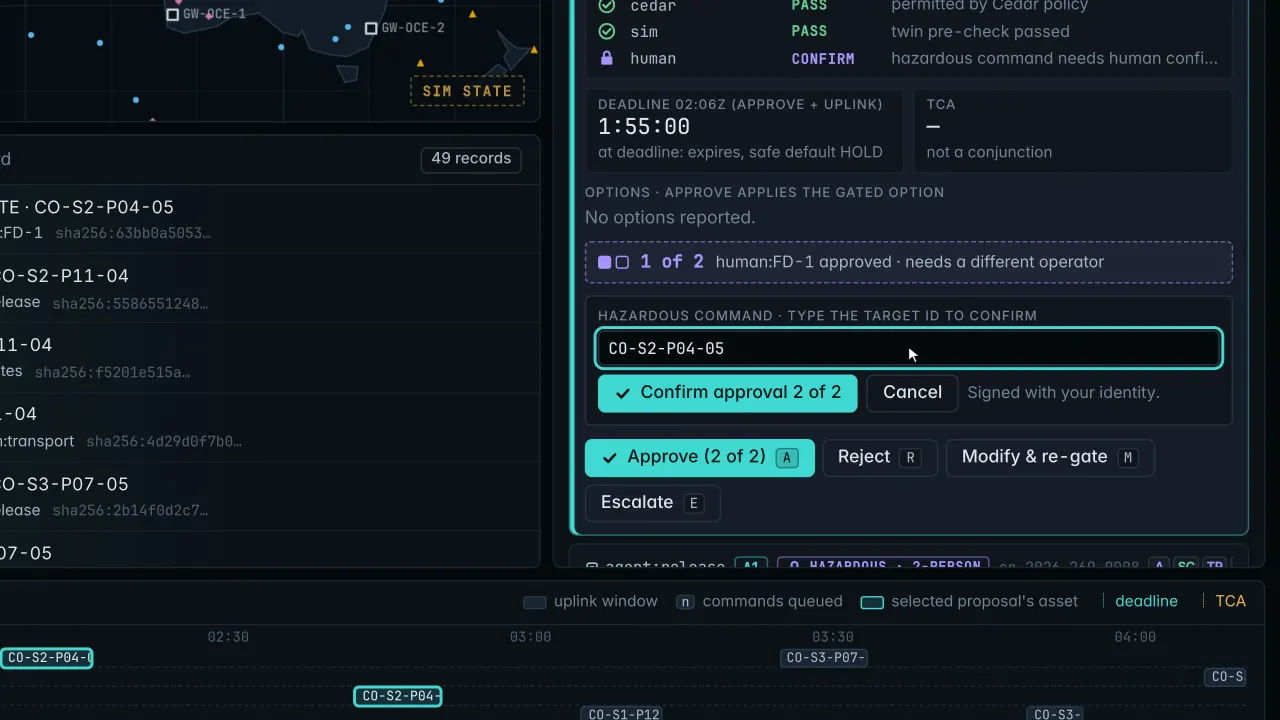
Two-person rule, second approver: 'FD-1 approved · needs a different operator'; OPS-ENG-A confirms approval 2 of 2.
What this showsTwo-person rule, second approver: 'FD-1 approved · needs a different operator'; OPS-ENG-A confirms approval 2 of 2.
Recorded replay · demonstration, not a benchmark [clip 2]Map positions illustrative [map 3]
Operations console · Staged rolloutsReplay
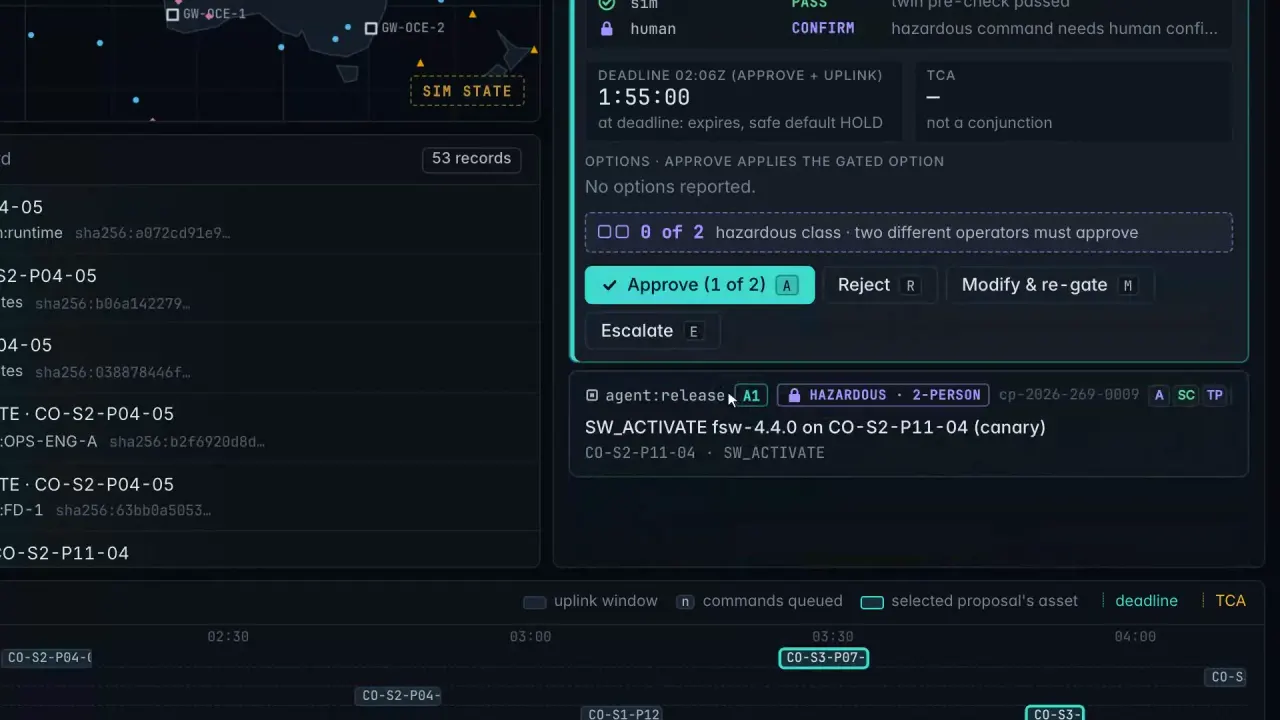
What this showsFlight-software activation is hazardous: FD-1 approves first, then a different operator, OPS-ENG-A, types the spacecraft ID and gives the second approval. It is never batch-approved.
Recorded replay · demonstration, not a benchmark [clip 2]Map positions illustrative [map 3]

What it is not

Not a build or signing system for flight software.

The limits, listed
  • Not a build or signing system for flight software.
  • Not autonomous promotion.

§ · NEXT PASS

Request a briefing.

A 45-minute session with the evidence behind any figure. Operators can send a week of their queue.

This address is used only to reply to you. The site sets no cookies and loads no trackers.

Briefing requests

About the clips and captures on this page

  1. Rendered offline (2D canvas) from the ConstellOps v1.0.0rc4 staged-rollout showcase event stream: the rollout plan's waves, per-spacecraft load, activation and rollback times, the comparator's halt and regressed metrics, and the two-person approvals by FD-1 and OPS-ENG-A. Ring membership beyond the canary is illustrative.
  2. ConstellOps operations console v1.0.0rc4, showcase, replay of recorded Amazon Nova Pro calls, in-memory link, simulated clock. Single demo run, not a benchmark.
  3. Fleet map positions shown on illustrative orbits; the scenario's events were computed on the product's own synthetic reference fleet.

Sources and labels for every figure on this page (8)

  1. 20 of 20 Bad-build rollouts halted before the full fleet: 20 of 20

    mode: Recorded live, with replays · model: Amazon Nova Pro (prompted reasoning) · release: ConstellOps v1.0.0rc4 · runs: 5 runs recorded live, 15 replayed · n: 20 seeds (20 runs, 5 recorded live and 15 replayed) · 95% range: 0.832–1 · scenario: staged rollout with a canary regression

  2. 5 About 5 satellites on the bad build before the halt (mean 4.95 over 20 runs)

    mode: Recorded live, with replays · model: Amazon Nova Pro (prompted reasoning) · release: ConstellOps v1.0.0rc4 · runs: 5 runs recorded live, 15 replayed · n: 20 seeds (5 recorded live, 15 replayed) · scenario: staged rollout with a canary regression

  3. 6 Canary wave: 6 spacecraft of a 300-spacecraft fleet

    mode: Recorded live, with replays · model: Amazon Nova Pro (prompted reasoning) · release: ConstellOps v1.0.0rc4 · runs: 5 runs recorded live, 15 replayed · n: 20 seeds (the same in every run) · scenario: staged rollout with a canary regression

  4. 0.45 h Time from first install to halt: 0.45 h (about 27 min)

    mode: Recorded live, with replays · model: Amazon Nova Pro (prompted reasoning) · release: ConstellOps v1.0.0rc4 · runs: 5 runs recorded live, 15 replayed · n: 20 seeds (20 runs, 5 recorded live and 15 replayed) · 95% range: 0.392–0.517 · scenario: staged rollout with a canary regression

  5. 0 of 20 Bad build beyond the canary: 0 of 20 rollouts

    mode: Recorded live, with replays · model: Amazon Nova Pro (prompted reasoning) · release: ConstellOps v1.0.0rc4 · runs: 5 runs recorded live, 15 replayed · n: 20 seeds (20 runs, 5 recorded live and 15 replayed) · 95% range: 0–0.168 · scenario: staged rollout with a canary regression

  6. 0 of 306 Unsafe uplinks under the two-person rule: 0 of 306

    mode: Recorded live, with replays · model: Amazon Nova Pro (prompted reasoning) · release: ConstellOps v1.0.0rc4 · runs: 5 runs recorded live, 15 replayed · n: 306 uplinked commands over 20 rollout runs, re-verified against the pinned rulebook (two distinct approvers for software activate and rollback) · 95% range: 0–0.012 · scenario: staged rollout with a canary regression

  7. 20 of 20 Runs that replay identically: 20 of 20

    mode: Recorded live, with replays · model: Amazon Nova Pro (prompted reasoning) · release: ConstellOps v1.0.0rc4 · runs: 5 runs recorded live, 15 replayed · n: 20 seeds · scenario: staged rollout with a canary regression

  8. 27.4 ConstellOps approval records per episode under its A1 policy (two-person software actions counted twice): 27.4

    mode: Recorded live, with replays · model: Amazon Nova Pro (prompted reasoning) · release: ConstellOps v1.0.0rc4 · runs: 5 runs recorded live, 15 replayed · n: 20 seeds (20 rollout runs) · 95% range: 25.7–28.9 · baseline: policy count · scenario: staged rollout with a canary regression (not matched; approval policy count only)